
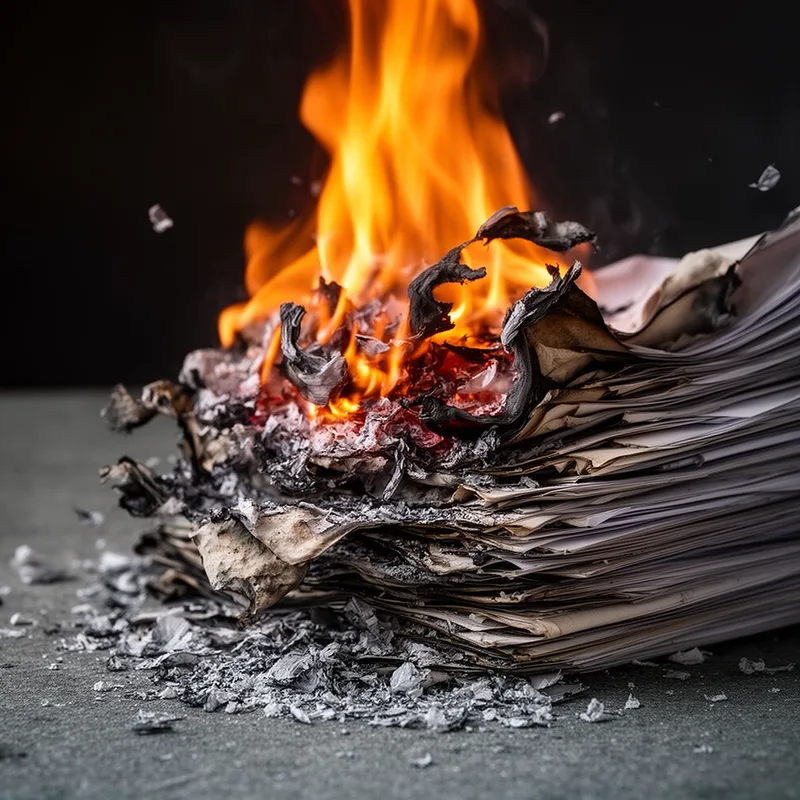
to burn up
 27
3.7
27
3.7

- phrasal verb
- /bɜrn ʌp/
- It will probably crash in the ocean or burn up in the atmosphere.
- the fire burned up
- the house was burned up
- the spacecraft burned up
Loading YouTube…
Watch on YouTubeAnd so maybe some of the bigger things that didn't burn up are, are out there too.
- And so maybe some of the bigger things that didn't burn up are, are out there too.
- But it all burns up like paper and fire.
- But the things of this world, they're going to burn up.
- But in secret, when the sun comes up, everything will be burnt up.
- He said what what survives after we die so that this body clearly dies and goes into the ground or it's burned up or it goes away, right.
- And that Ranger gave it to Gabe and told him that that was the only thing that wasn't burnt up in that crash.
- They put all of their poop into this layer and it burns up.
- And this is me just being I I pray that I I pray that whoever goes to hell gets burnt up and then no longer exists annihilation.
- They're more concerned about the fact that he just burned up their livelihood and it turns into all out war between Samson and the Philistines.
- A lot of it may have been chewed up, burned up over the years, shredded.
- For some reason the back of those always burn up.
Examples
-
Nearly all of these burn up in the atmosphere before hitting the Earth.
Blog text (1) -
The whole system might as well have burned up.
Fiction book (1997) -
The fact is that if we were any closer to the sun, we would burn up.
Blog text (10) -
I saw what was left of it after it burned up.
-
All the evidence burned up.
-
All the cameras and the drives burned up in the fire.
-
Didn't they burn up in that fire yesterday?
-
After a mission concludes, the satellites burn up in the lower atmosphere.
Blog text (10) -
The firefighter manifest listed $15,000 in cash that burned up in the fire.
-
The old warehouse burned up completely in the fire last night.
Synonyms
 ∞
1.0
∞
1.0
To be on fire or damage something with heat
 121
3.0
121
3.0
To destroy a building or object completely by fire
 43
4.4
43
4.4
To be destroyed by fire
 31
4.8
31
4.8
To burn something completely so it is destroyed
 8
7.4
8
7.4
To burn until it turns to ash
 7
4.3
7
4.3
Badly damaged or destroyed by fire
 6
3.2
6
3.2
Become used up by fire or slowly disappear over time from heat and light
 2
6.4
2
6.4
Completely destroyed by fire so nothing remains but burned pieces

Damaged by fire or very strong heat

Completely destroyed so nothing is left
Antonyms

How Destroyed

Surface Forms
Morphology
burn + up
The meaning 'to be completely destroyed or consumed by fire' is compositionally derivable from 'burn' (to be consumed by fire/consume) plus the particle 'up', which commonly adds a completive/totality sense. This phrasal-verb pattern is frequent and cross-linguistically accessible, so a B1 learner who knows the constituent words would likely infer the intended meaning.
Etymology
The phrase burn up comes from things being caught by fire and burned up until nothing is left, as when a house or papers are eaten by the flames. So if something 'burns up', it is 'completely destroyed by fire'.