
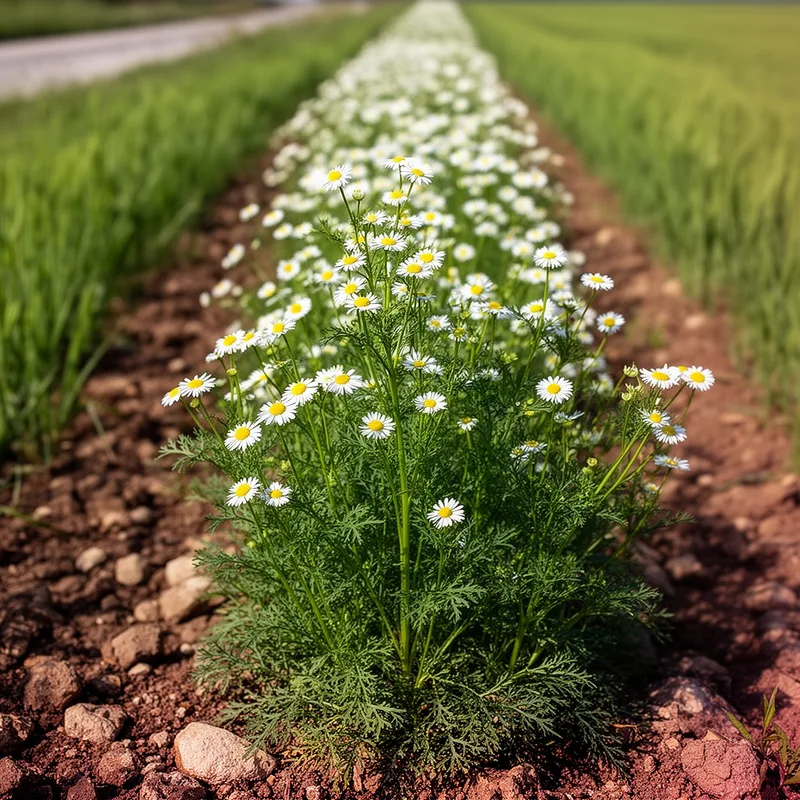
Matricaria inodorum
- noun
- Specialized
- Matricaria inodorum is identified by its finely divided leaves and small white flowers, distinguishing it from other plants.
Examples
-
Farmers frequently identify Matricaria inodorum as a troublesome weed in their fields.
-
Matricaria inodorum often invades disturbed soils and roadsides across much of Europe and North America.
-
Although called scentless mayweed, Matricaria inodorum sometimes has a faint fragrance when crushed.
-
The Matricaria inodorum is often found in gardens.
-
Have you seen the Matricaria inodorum growing in the field?
-
Matricaria inodorum, commonly known as scentless mayweed, can often be seen growing in empty lots and along roadsides.
-
Many gardeners consider Matricaria inodorum a weed due to its rapid growth and ability to spread quickly.
Synonyms

A common annual weed with white daisy-like flowers and no smell

A common wild plant with small white flowers that grows like a weed
A common weed with white flowers and thin, divided leaves that looks like chamomile

A small plant with white daisy-like flowers that has little or no smell
A common wild plant with small white daisy-like flowers, thin divided leaves, and little smell that grows in fields
Surface Forms
Morphology
Matricaria + inodorum
This is a Latin scientific binomial rather than a compositional English phrase: 'Matricaria' names a plant genus (chamomile group) but 'inodorum' is a Latin epithet not attested in the provided dictionary entry. A B1 learner who only knows ordinary English vocabulary (and not Latin botanical epithets) would not be able to derive the specific meaning or descriptive details from the constituents, so the expression is not transparently interpretable.
Etymology
Matricaria inodorum comes from old Latin words. Matricaria was a name for plants linked to mothers ('matrix') and inodorum means 'without smell', so the name points to a 'scentless' plant and explains the common name 'scentless mayweed'.

