

Eichhornia crassipes
- noun
- /ˌaɪkˈhɔːrniə ˈkræsɪpiːz/
- Specialized
- Eichhornia crassipes can quickly overtake ponds and rivers, blocking sunlight and depleting oxygen.
Examples
-
The rapid growth of Eichhornia crassipes has made it a major pest in southern water systems.
-
Efforts to control Eichhornia crassipes often involve mechanical removal from crowded waterways.
-
The Eichhornia crassipes is often seen in ponds.
-
Look at the Eichhornia crassipes flowers!
-
Eichhornia crassipes can quickly overpopulate waterways, causing significant ecological damage.
-
Due to its invasiveness, Eichhornia crassipes often clogs irrigation systems and drains.
-
Many ecosystems struggle to cope with the spread of Eichhornia crassipes in their lakes and rivers.
Synonyms

A floating plant with thick leaves and blue or purple flowers that grows fast and blocks rivers

A tropical water plant with floating leaves and big blue flowers that can block waterways

A tropical water plant with floating leaves and large blue flowers that clogs rivers and lakes
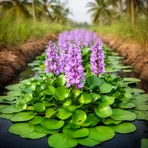
A tropical water plant with round floating leaves and purple flowers
How Invasive
- Specialized

- Specialized
 1
4.8
1
4.8

- Specialized
- US

 1
5.1
13
3.9
1
5.1
13
3.9
Surface Forms
Morphology
Eichhornia + crassipes
This is a Latin binomial (scientific name). Even if a learner knew the genus element as an aquatic plant, the species epithet is a Latin term (often not transparently meaningful to B1 learners) and the full name functions as a proper taxonomic label rather than a compositional English phrase, so the specific sense ‘water hyacinth’ and its connotations are not predictable from the parts.
Etymology
Eichhornia crassipes is the scientific name for the common 'water hyacinth'. The first part, Eichhornia, may be named after a person called Eichhorn, and the second part, crassipes, comes from Latin meaning 'thick foot' and describes the plant's thick, spongy stalks that help it float and form mats that clog waterways.