

water hyacinth
- noun
- /ˈwɔːtər ˈhaɪəsɪnθ/
- US
- By 1992, water hyacinth had invaded hundreds of lakes and streams throughout the South and parts of the West and Hawaii.
- water hyacinth plant
- an alien water hyacinth
Examples
-
Due to the rapid growth of water hyacinth, the local ecosystem has faced significant challenges.
-
Water hyacinth was one of the original targets and remains a high priority today.
Academic text (2000) -
More typically, water hyacinth damages water quality by blocking sunlight and oxygen and slowing the water's flow.
Academic text (2000) -
The natural beauty of water-hyacinth's flower and foliage has helped it spread to become a floating nightmare in many tropical and subtropical areas.
Academic text (2000) -
Community members, however, were resourceful enough to convert the stalks of these water hyacinth into material that looked like leather when a shiny coat was applied to it.
Academic text (2016) -
In the summer of 1998, hydrilla and water hyacinth—alien additions to the Texas landscape—thrived in waterways that nearly dried up during the drought.
Academic text (1999) -
Guides often bring travelers through the Marimbus Marsh, a maze of rills between stands of papyrus and water hyacinth, to swim in the waterfall.
Academic text (2007) -
The river was filled with water hyacinth, making it difficult for boats to pass.
-
Farmers struggled to catch fish because the pond was covered in thick layers of water hyacinth.
Synonyms
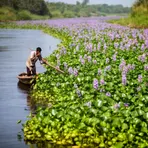
A floating plant called water hyacinth with thick leaves and purple flowers that grows fast and clogs waterways
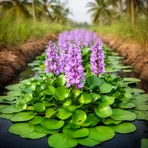
A tropical water plant with round floating leaves and purple flowers

A tropical water plant with floating leaves and big blue flowers that can block waterways

A tropical water plant with floating leaves and large blue flowers that clogs rivers and lakes
How Invasive


Surface Forms
Morphology
The meaning 'a hyacinth that grows in water' is directly and compositionally derived from combining 'water' (aquatic) with 'hyacinth' (a flowering plant); the compound simply specifies the habitat/type of hyacinth. This noun–noun modifier pattern is common across languages, so a B1 learner who knows both constituents would readily infer it refers to an aquatic plant.
Etymology
The name water hyacinth comes from how it looks: it is a floating plant with pretty flowers, so people joined water and hyacinth, a garden flower, to name it. Because it spreads very fast and makes thick mats that 'clog waterways', people remember it as a troublesome water weed.