

to wash the dishes
 42
1.0
42
1.0

- phrasal verb
- After dinner, it was my turn to wash the dishes before we could relax.
Loading YouTube…
Watch on YouTubeThat's just washing the dishes before they go in the dishwasher.
- That's just washing the dishes before they go in the dishwasher.
- And I always give this very small example from my own home, but in my house, we used to eat, hang out, and then at the end of the night we'd wash the dishes.
- And then though I'm washing the dishes and get getting it done.
- What was that whole the paragraph before she's she's washing the dishes and then something floats past the hedges.
- No, I still been washing the dishes, but this is the lesson I think we need to learn.
- So we keep washing and washing the dishes, I think just to get our mind from the open ocean that you see out there.
- You are able to do manual work because of the manual work, because you are washing the dishes, because you touch the the earth, because you're lifting the stones.
- You are able to do manual work because of the manual work, because you are washing the dishes, because you touched the the earth, because you're lifting the stones.
Examples
-
I had breakfast by myself and then washed the dishes.
-
Well, since you've made the beds, you can wash the dishes, and tidy up the camp.
-
Everyone has to wash the dishes at least once a week.
-
Why is my brother being late to play and I have to stay and wash the dishes and stuff like that?
-
Why should I even make the bed or wash the dishes?
-
Now you wash the dishes.
-
You want to wash the dishes?
-
After we ate, we had to wash the dishes and clean the lampshades.
Fiction book (1993) -
As we slipped out the kitchen's glass door, she was standing at the sink, washing the dishes.
Academic text (2013) -
Tamborel helped clear the table and wash the dishes, sighing loudly all the while.
Fiction book (1993)
Synonyms
 52
1.0
52
1.0
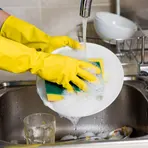
To wash plates, cups, and other things used for eating after a meal
 41
1.1
41
1.1
To wash the dishes after a meal
How Clean

Surface Forms
Morphology
The meaning 'to clean plates and other eating utensils' is directly and compositionally derived from the verb 'wash' (to clean with water/soap) applied to the noun 'dishes' (plates, bowls, etc.), with 'the' as a simple determiner. This is a common, literal action construction found across languages and will be immediately understandable to a B1 learner who knows the constituent words.
Etymology
Wash the dishes comes from the simple picture of using water and soap to wash dirty dishes after a meal, so it means 'to clean plates, bowls, and cups'.