

visual impairment
 1
4.1
1
4.1

- noun
- /ˈvɪʒuəl ɪmˈpɛərmənt/
- Two studies investigated the self-concepts of children with visual impairments in different class placements, with similar results.
- students with visual impairments
- children with visual impairments
- people with visual impairments
Loading YouTube…
Watch on YouTubeA sign warns against visual impairment and sandstorms.
- A sign warns against visual impairment and sandstorms.
Examples
-
The unique needs of students with visual impairments can best be met while attending public schools.
Academic text (1996) -
As Table 3 indicates, the participants with visual impairments performed worse than the sighted participants.
Academic text (2008) -
How were they involved in the education of their own children who had visual impairments?
Academic text (2008) -
Many people with visual impairments are are able to see somewhat.
-
At the same time, teachers of students with visual impairments prepare learning environments for their students.
Academic text (1992) -
For example, it will be necessary to familiarize students who have visual impairments with the surroundings.
Academic text (1996) -
The most frequently listed disability was visual impairment, reported by 25.2% of all freshmen with a disability.
Academic text (1995) -
Students with visual impairment often benefit from specialized teaching methods to enhance their learning.
-
The organization provides resources for individuals living with visual impairment to navigate daily challenges.
-
During the workshop, experts shared techniques to support those with visual impairment in achieving independence.
Synonyms
 70
3.1
70
3.1
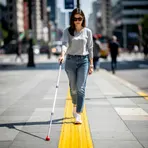
A condition in which a person cannot see because of injury, disease, or being born that way
 21
6.1
21
6.1
An eye disease that damages the nerve at the back of the eye and can lead to blindness
 20
5.2
20
5.2
A cloudy lens in the eye that makes vision blurry
 3
6.3
3
6.3
Loss of central vision when the part of the eye that sees fine detail gets weak
 3
7.5
3
7.5
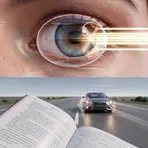
An uneven curve in the eye that makes vision blurred or distorted
 2
3.3
2
3.3
A health problem that affects the eye and can harm vision
 2
8.1
2
8.1
A disease of the back part of the eye that can cause loss of sight
 2
3.7
2
3.7
A problem with seeing where things far away look blurry
 1
3.4
1
3.4
A problem with the eye that affects vision

 1
4.0
1
4.0
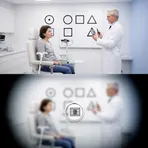
Very poor sight that the law measures as 20/200 vision or a very small field of view
 1
3.7
1
3.7
Not able to tell some colors, often red and green
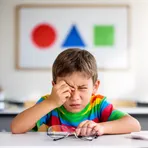
A problem with the eyes that makes it hard to see clearly

A problem in the eyes that makes it hard to see

A problem with your sight that makes things look unclear

Loss of sight because an eye is missing or badly damaged

Not being able to see

A condition of having no eyes, often from birth or injury

A problem with the eye or a lens that makes images look blurred and stretched

Difficulty seeing things far away without glasses
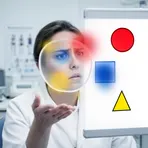
A person not able to see shapes or outlines
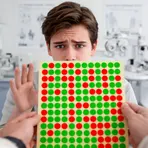
A problem where a person cannot tell some colors apart, often red and green

A condition in which a person sees the world only in shades of gray
Antonyms

How Severe

Surface Forms
Morphology
The meaning 'a condition of reduced or lost vision' is directly derivable from combining 'visual' (related to sight) with 'impairment' (diminished ability), so a learner who knows both words can infer the compound meaning. This adjective+noun composition is a straightforward, cross-linguistic descriptive pattern commonly used in medical and everyday contexts, making it immediately comprehensible to B1 learners.
Etymology
Visual impairment comes from two simple words: visual meaning 'seeing' and impairment meaning something that makes that ability worse. Imagine a camera lens with a smudge that makes the picture blurry or dark, so it cannot see clearly. So, visual impairment means 'partial or total loss of vision'.