
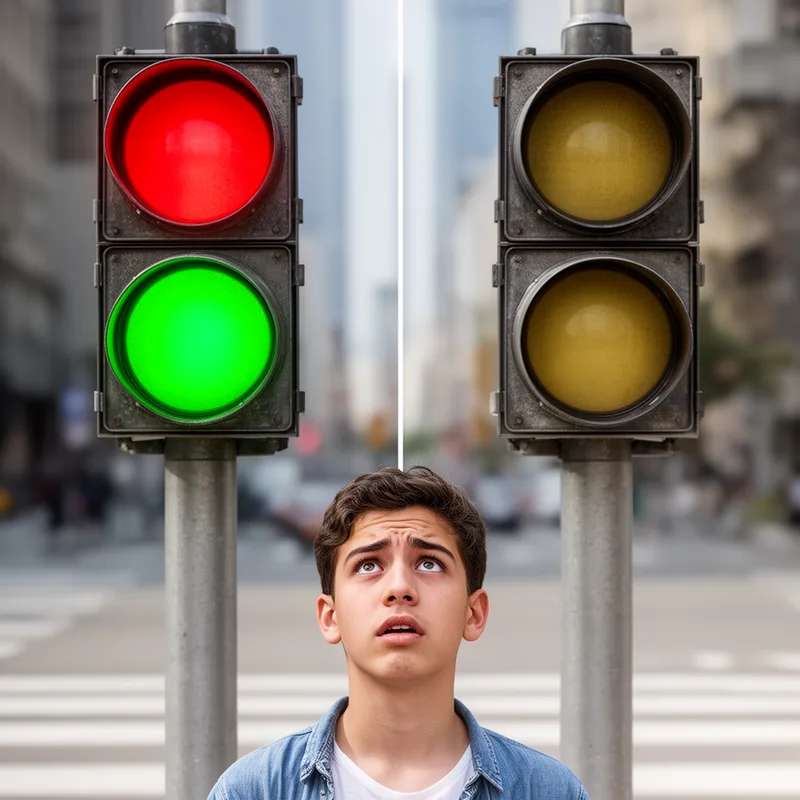
color blindness


 1
3.7
1
3.7
- noun
- /ˈkʌlər ˈblaɪndnəs/
- US
- When designing websites, it's important to avoid using color combinations that may confuse individuals with color blindness.
Loading YouTube…
Watch on YouTubeSo that if I, you know, think that this is a red chair and then I find out that I actually have red, green color blindness and it's, it's really a green chair.
- So that if I, you know, think that this is a red chair and then I find out that I actually have red, green color blindness and it's, it's really a green chair.
Examples
-
The Chief Constable of Hertfordshire Constabulary ruled that the fact that the officer was removed from operational duties because of his color-blindness amounted to indirect discrimination on the grounds of sex.
Academic text (2014) -
And in fact, we do call color blindness Daltonism.
-
So that if I, you know, think that this is a red chair and then I find out that I actually have red, green color blindness and it's, it's really a green chair.
-
My mother even had me tested for color blindness, since I seemed to have no problems anywhere else, but according to the test, I saw color just fine.
Blog text (11) -
The colors of dots and stars were selected so that people with any of the four types of color blindness would be able to differentiate between fiction and nonfiction.
Academic text (2013) -
The aspiring officer, who wished to preserve his anonymity, had passed all the other tests to allow him to begin training, but was told his moderate color-blindness meant he would be unable to pursue a career in the force.
Academic text (2014) -
About 8% of boys experience some form of color blindness, affecting their ability to differentiate certain colors.
-
During the exam, he realized his color blindness made it difficult to identify some of the questions related to color matching.
Synonyms

A problem where a person cannot tell some colors apart, often red and green

Difficulty telling red and green colors apart

A vision problem that makes red and green look similar

A reduced ability to see red light that makes people confuse red and green

A condition that makes it hard to see the difference between red and green colors

A condition that makes it hard to tell green from red or purple

Trouble telling red from similar colors like purple

A condition that makes green look like red

A rare kind of color blindness that makes blue and yellow hard to tell apart

A condition that makes it hard to tell yellow and blue apart

Difficulty seeing the difference between yellow and blue

Difficulty telling blue and yellow colors apart

A condition in which a person cannot see yellow colors well

A rare eye condition that makes yellow colors hard to see

A condition where a person sees colors with only two types of cells, making red and green hard to tell

A color vision problem where a person sees only two colors and uses two types of light to match others

A condition in which a person sees colors using only two kinds of light instead of three

A vision condition where a person can match any colour using only two colours of light instead of three

A condition where a person sees fewer colors and often confuses red and green

A condition in which someone sees only shades of gray and not colors

A condition in which a person sees only shades of gray

People with complete color blindness see only shades of gray

A condition in which a person sees the world only in shades of gray

A condition in which a person can only see shades of light and dark

A condition in which a person cannot see colors and only sees shades of gray
A lack of color in vision or objects
Antonyms

How Color-Sensitive

Surface Forms
Morphology
The compound uses a straightforward metaphor: combining 'color' with 'blindness' signals being 'blind to color' — i.e., ignoring racial differences — so a learner who knows both words could plausibly infer a meaning like 'not seeing or considering race'. However, the phrase extends beyond the literal medical sense into a sociopolitical concept with critical nuance (masking systemic inequality), so the precise ideological sense and its evaluative implications are not fully predictable without prior exposure.
Etymology
Color blindness comes from medicine: the words color and blindness make a picture of someone who is 'blind' to certain colors and so cannot tell them apart. So color blindness means an inability to see or distinguish some colors.