

deuteranopia
- noun
- /ˌdjuːtərˈænəpiə/
- Specialized
- The genetic mutation responsible for deuteranopia is most commonly inherited from the mother.
Examples
-
People with deuteranopia may have trouble telling the difference between red and green traffic lights.
-
After testing, he was diagnosed with deuteranopia, which affects approximately 1% of males.
-
People with deuteranopia often struggle to differentiate between red and green.
-
Is deuteranopia a common type of color blindness?
-
A person with deuteranopia may struggle to tell red stop signs from green traffic lights.
-
Due to deuteranopia, he often confuses green apples with red ones.
-
Living with deuteranopia, she sometimes relies on her friends to help her choose the right clothes.
Synonyms


 1
3.7
1
3.7
Not able to tell some colors, often red and green

A condition that makes it hard to tell green from red or purple

A condition that makes green look like red

A vision problem that makes red and green look similar

Difficulty telling red and green colors apart
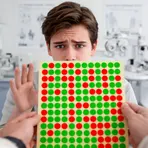
A problem where a person cannot tell some colors apart, often red and green

A condition where a person sees fewer colors and often confuses red and green

A condition where a person sees colors with only two types of cells, making red and green hard to tell

A color vision problem where a person sees only two colors and uses two types of light to match others

A condition in which a person sees colors using only two kinds of light instead of three

A vision condition where a person can match any colour using only two colours of light instead of three
Antonyms

- Specialized
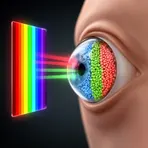
Seeing many colors normally because the eyes have three kinds of color cells
How Severe

Surface Forms
Morphology
deuteranopia = deuter + anopia
A medical formation from Greek combining forms (e.g., 'deuter-' and 'anopia') that are not standalone English words, so learners cannot reliably infer the meaning from familiar English bases.
Etymology
Deuteranopia comes from Greek parts deuter- meaning 'second' and -opia meaning 'vision', the same -opia in myopia. So, it names a color problem caused by a weak or missing 'second' type of color-sensing cell in the eye, the one for green, and that is why people with deuteranopia have trouble telling red and green apart.