
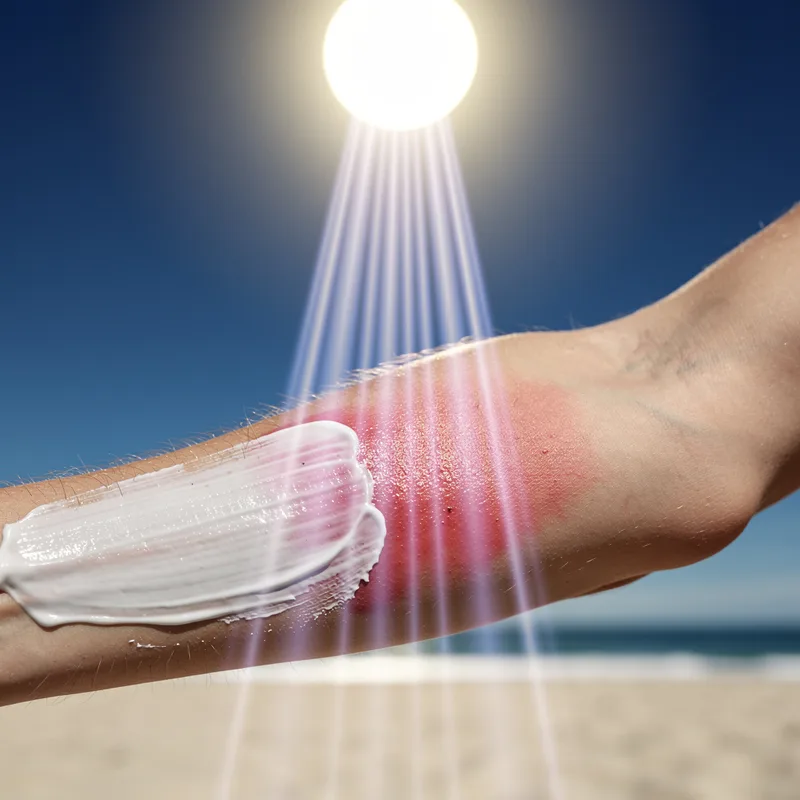
ultraviolet radiation
 4
4.1
4
4.1

- noun
- /ˌʌltrəˈvaɪəlɪt ˌreɪdiˈeɪʃən/
- Specialized
- Wearing sunscreen helps protect your skin from the harmful effects of ultraviolet radiation.
- solar ultraviolet radiation
- ultraviolet radiation from the sun
- harmful ultraviolet radiation
Examples
-
Ultimately, however, CFCs lead to ozone loss and a consequent increase in ultraviolet radiation.
Academic text (1998) -
Ozone in the Earth's stratosphere absorbs ultraviolet radiation, and absorbing this energy warms the stratosphere.
Blog text (34) -
The impacts of increasing levels of ultraviolet radiation.
Academic text (1999) -
It's because the sun is so hot that it exudes ultraviolet radiation as well.
-
Ultraviolet radiation may be harmful to unaccustomed eyes.
-
The 1950s were marked by an intensive effort to study solar X-rays and ultraviolet radiation.
Academic text (1991) -
Energetic flares increased the Sun's ultraviolet radiation by at least 16 percent.
Blog text (34) -
Results showed that people generally understood the long-term risk from exposure to ultraviolet radiation, but did not routinely use sun-protective clothing to avoid it.
Academic text (2005) -
Solar ultraviolet radiation is absorbed in the upper atmosphere, heating it to about 3,000 degrees Fahrenheit.
Academic text (1990) -
The ozone layer in the Earth's stratosphere filters harmful ultraviolet radiation and prevents it from reaching the Earth's surface.
Academic text (1992)
Synonyms
 14
5.1
14
5.1
Invisible light with waves shorter than visible light that can cause sunburn
 10
4.0
10
4.0
A type of light from the sun that you cannot see and that can burn your skin
 5
3.9
5
3.9
A strong invisible light from the sun that can damage skin and kill germs
Invisible light that can burn or damage skin

Invisible light beyond the violet end of visible light

A type of light, often ultraviolet, that can cause chemical changes
How Ionizing
- Specialized
3
6.5

- Specialized
99
3.2
- Specialized
4
4.1
Surface Forms
Morphology
The phrase 'ultraviolet radiation' is directly compositional: 'ultraviolet' specifies a portion of the spectrum (beyond violet) and 'radiation' denotes emitted energy, so a learner who knows both constituents can infer it means radiation with wavelengths shorter than visible light and likely causing sunburn. This modifier+noun pattern is technical but follows regular composition and has close equivalents in many languages, making it transparent to B1 learners familiar with the component words.
Etymology
Ultraviolet radiation gets its name because it is light just 'beyond' the purple color violet we can see, and ultra means beyond. This invisible, more powerful light from the sun can reach skin and cause 'sunburn', so the name shows it is light past violet, not normal visible light.