
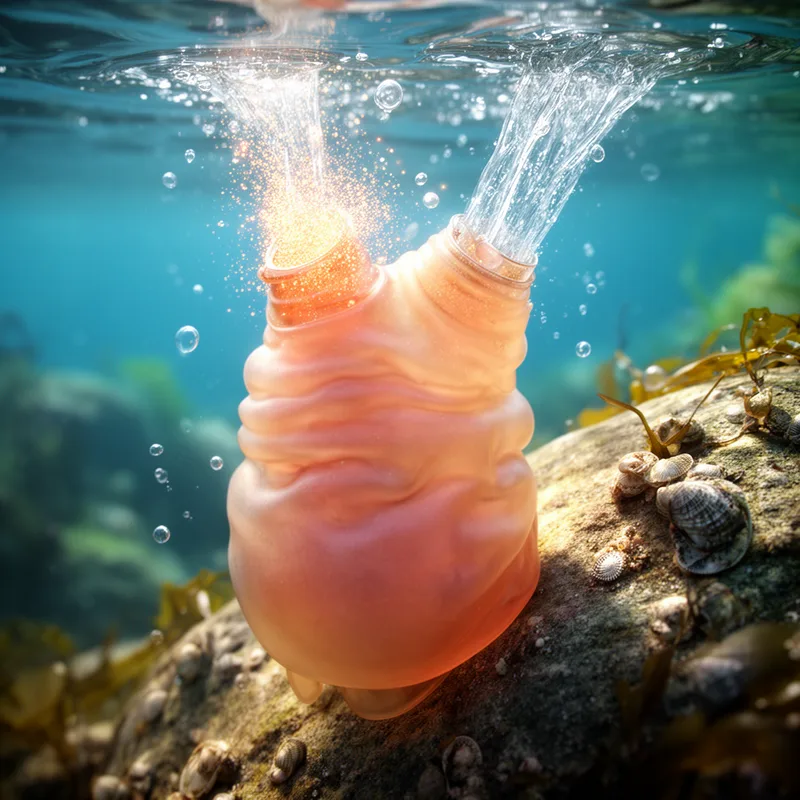
tunicate


 1
9.9
1
9.9
- noun
- /ˈtjuːnɪkeɪt/
- Specialized
- And these little tunicates were were talked about, Lancaster talked about in his degeneration.
Examples
-
Tunicates, Molgula manhattanensis, frequently are common on the beds.
Academic text (1996) -
The tunicates, nacreous and as pale as a dead man's fingers, also seemed part of the fabric of the rock.
Academic text (1992) -
And it is relatively simple now to differentiate a tunicate from a human.
Blog text (16) -
Until a giant five-fingered hand reaches down from the sky and tries to sample the tunicate that it happens to be crawling on.
Blog text (17) -
I cannot deny that human and tunicate zygotes are essentially the same in substance, but I do deny that they are very different in kind.
Blog text (16) -
Bristled polychaete worms insinuated themselves in this living terrain, and sometimes entered the siphons of sponges and tunicates.
Academic text (1992) -
More remarkably, tunicates have larvae that resemble tadpoles, complete with a dorsal nerve cord and a rudimentary backbone called a notochord.
Academic text (1992) -
The tested TED was very effective in reducing horseshoe crab, cannonball jellyfish, stingray, and tunicate catches, with an overall by-catch reduction of 24 percent (21 percent for the 15 tows above).
Academic text (1991) -
Another find from the sea: the tunicate, which sits motionless on a canyon wall with a translucent body and a big, open mouth.
-
The tunicates, nacreous and as pale as a dead man's fingers, also seemed part of the fabric of the rock.
Synonyms

A simple sea animal with a baglike body and a stiff rod in its young form
Sea animals with a sac-like body and a tough outer covering
Sea animals with a sac-like body and a tough outer covering, like sea squirts
Sea animals that have bag-shaped bodies and a tough outer covering and that filter water to feed, like sea squirts

A group of sea animals like sea squirts with a bag-like body and a tail in the young stage
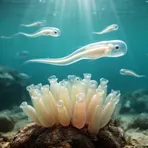
A group of sea animals like sea squirts with a sac-like body and a backbone-like rod when young
Surface Forms
Morphology
Etymology
Tunicate comes from the Latin tunica, which means 'tunic' or 'coat'. These sea animals have a small, bag-like body with an outer 'coat', so the name helps you remember their tunic-like covering.