
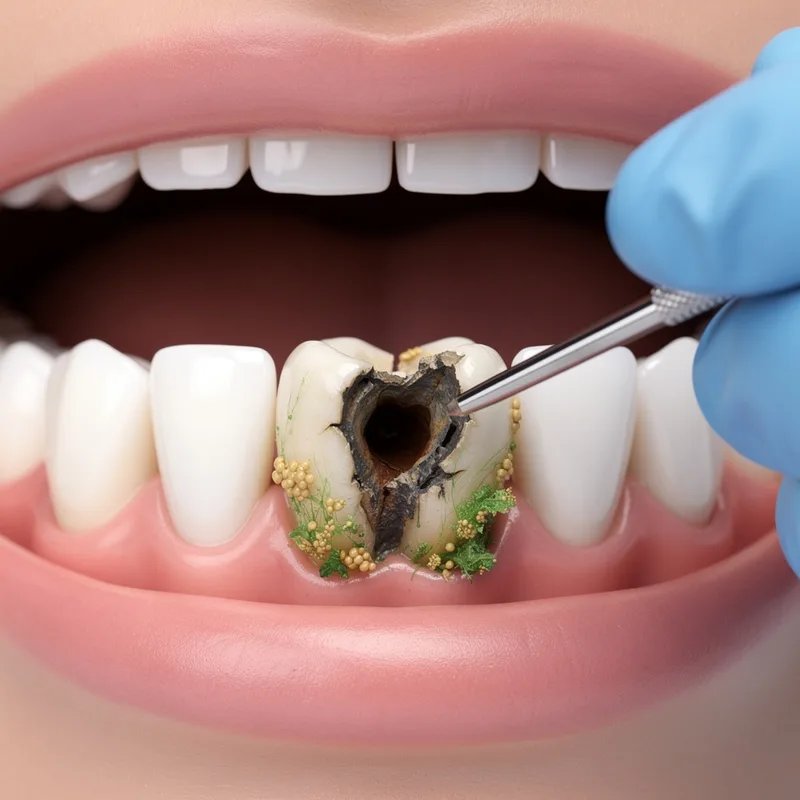
tooth decay
 5
2.2
5
2.2

- noun
- /tuːθ dɪˈkeɪ/
- Specialized
- If the chewing gum contains a sugar-free sweetener, Xylitol, it is a safeguard against tooth decay.
- prevent tooth decay
- cause tooth decay
- sugar causes tooth decay
Loading YouTube…
Watch on YouTubeIt turns out, as you know, fluoride prevents tooth decay.
- It turns out, as you know, fluoride prevents tooth decay.
Examples
-
Glucan builds up and turns into plaque, the leading cause of tooth decay.
Blog text (14) -
In addition, Latino children have the lowest attendance for dental care and the highest proportion of children with untreated tooth decay.
Academic text (2012) -
Plus, it helps prevent tooth decay.
-
Of the children living in the same area today, 85% of children have tooth decay, and 47% had mouth pain.
Blog text (30) -
Do not ignore the bad breath, as it may be a sign of tooth decay or gum disease.
Blog text (16) -
The teeth show no signs of periodontal disease or tooth decay.
Academic text (2002) -
Tooth decay, as you might expect, was rampant, impacting about 95% of the U.S. population.
Blog text (3) -
Recent studies have found an increase in tooth decay for the first time in 20 years.
-
The acid in soda can also dissolve tooth enamel and lead to tooth decay.
-
Excess refined sugar leads to obesity, but it is also one of the leading causes of tooth decay.
Synonyms
 37
4.4
37
4.4
To slowly fall into ruin because of age or neglect
 29
3.4
29
3.4
A hole in a tooth caused by decay
 24
1.6
24
1.6
The breaking down of things like food or wood by bacteria and mold


 1
4.1
1
4.1
Tooth decay caused by germs that makes a tooth soft and damaged

A hole or soft spot on a tooth caused by bacteria
Antonyms

How Severe

Surface Forms
Morphology
The meaning is directly and transparently derived from combining 'tooth' (a tooth) with 'decay' (the breakdown or rot of organic material), so a learner who knows both words can infer it refers to the deterioration of teeth. This noun–noun composition is a regular, cross-linguistically common pattern and does not require idiomatic knowledge, making it immediately comprehensible to B1 learners.
Etymology
Tooth decay comes from the simple picture of a tooth slowly decaying as tiny germs eat the sugar on it and make holes, like something left to rot. That's why it means 'the slow damage of a tooth that leads to cavities'.