
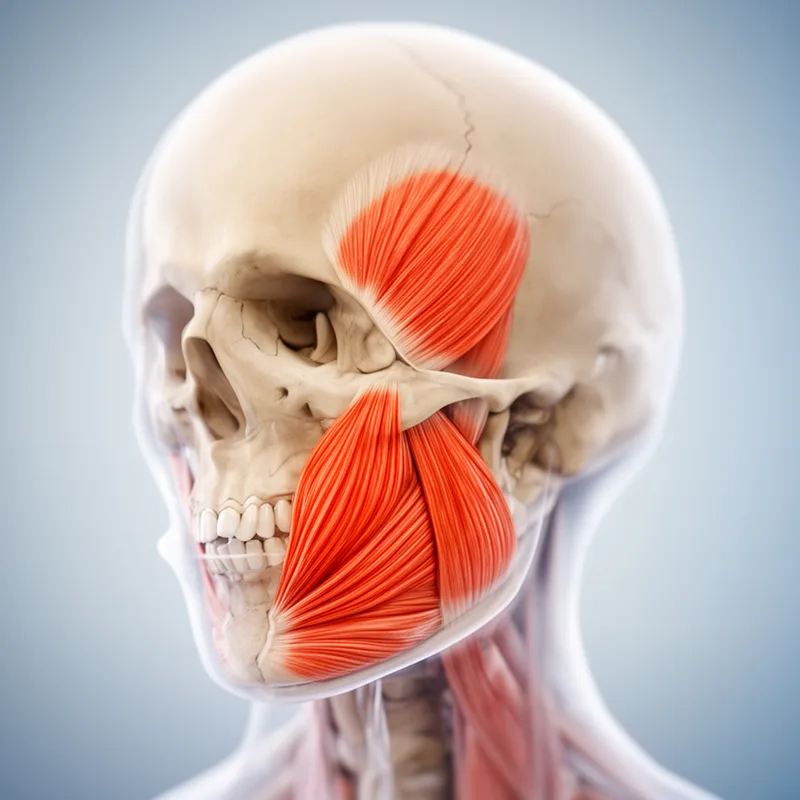
temporal muscle
- noun
- /ˈtɛmpərəl ˈmʌsəl/
- Specialized
- The temporal muscle helps move your jaw when you chew food.
Examples
-
- Yeah, you got some tightness in your temporal muscle, man.
-
We reconstructed the dura with fascia lata and temporal muscle.
Academic text (2003) -
She felt strain in her temporal muscle after clenching her teeth all night.
-
The surgeon explained the role of the temporal muscle in jaw movement.
Synonyms


 1
9.0
1
9.0
A broad fan-shaped muscle on the side of the head above the ear that helps close the jaw

A large muscle on the side of the head that lifts the lower jaw to close the mouth

A large fan-shaped muscle on the side of the head that helps raise and close the lower jaw
Surface Forms
Morphology
The meaning is directly compositional: 'temporal' (relating to the temple/side of the head) + 'muscle' clearly denotes a muscle located at the temple, so a learner who knows both words can infer it's an anatomical muscle involved in jaw movement/chewing. Although 'temporal' can also mean 'relating to time' in other contexts, the anatomical phrasing makes the intended sense obvious; similar formations appear across languages, supporting immediate comprehension.
Etymology
Temporal muscle combines temporal, a word for the temple or side of the head, and muscle. It is a wide, fan-shaped muscle in that area that pulls the lower jaw up when you chew, so it is the muscle used to 'raise' the lower jaw and 'close' the mouth.