

temporalis muscle
- noun
- /ˌtɛmpəˈrælɪs ˈmʌsəl/
- Specialized
- The temporalis muscle plays a crucial role in raising the lower jaw during chewing.
Examples
-
When the temporalis muscle contracts, it helps close the mouth more effectively.
-
Surgeons often utilize the temporalis muscle for reconstructive procedures in the jaw.
-
The ability to efficiently masticate was enhanced by an increase in the size of the temporalis muscle.
Academic text (2003) -
The eustachian tube orifice was sealed with temporalis muscle tissue.
Academic text (2007) -
The temporalis muscle and fascia, or septal cartilage, have traditionally been used as the base support of the repair, and both remain effective today.
Academic text (2008) -
The fascia is usually obtained through a postauricular incision from the lateral surface of the temporalis muscle.
Academic text (1995) -
The defect was then closed in three layers with temporalis fascia, temporalis muscle tissue, and homograft septal cartilage.
Academic text (2007) -
The middle cranial fossa approach carries significantly more morbidity primarily because of the long incision through the temporalis muscle and the exposure within the middle cranial fossa.
Academic text (1995)
Synonyms


 1
9.0
1
9.0
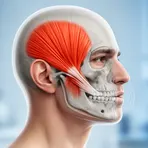
A broad fan-shaped muscle on the side of the head above the ear that helps close the jaw

A broad muscle on the side of the head that lifts the lower jaw to close the mouth

A large muscle on the side of the head that lifts the lower jaw to close the mouth
Surface Forms
Morphology
The phrase is compositional: 'temporalis' names a particular muscle (relative to the temporal region) and 'muscle' indicates bodily tissue that produces movement, so together they denote the muscle called the temporalis. Anatomical naming follows regular, transparent patterns (e.g., 'biceps muscle'), so a learner who knows both constituents can infer the meaning.
Etymology
The noun temporalis muscle gets its name from the word 'temple' because it sits on the side of the head at the temples. Its wide, fan shape reaches down to the jaw and helps close the mouth and chew, so the name shows both where it is and what it does.