
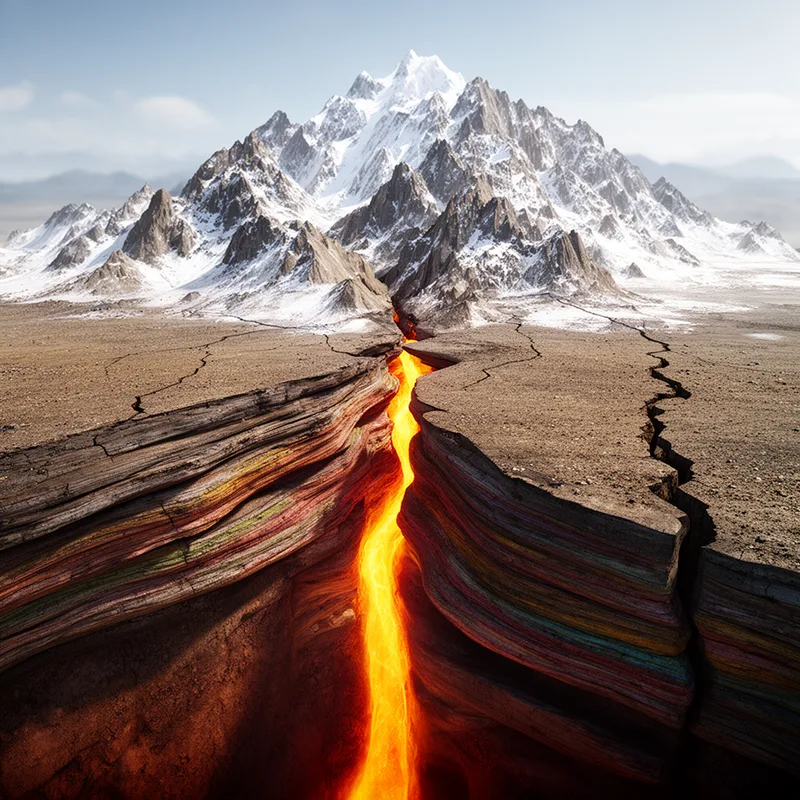
tectonic movement
 1
4.9
1
4.9

- noun
- /tɛkˈtɒnɪk ˈmuːvmənt/
- Specialized
- Scientists study tectonic movement to better understand the shifting of the Earth's plates.
Examples
-
Life arrived and blossomed once tectonic movements had pried the region's blocks of crust apart and tilted them to form mountains, providing the water from which all else flowed.
Academic text (2003) -
The tectonic movement of the Earth's crust can cause both earthquakes and volcanic eruptions.
-
One could suggest that the tectonic movements have some effect on these currents.
Blog text (10) -
It could be suggested that the tectonic movements have some effect on the balance of these currents.
Blog text (34) -
Several episodes of tectonic movement must have occurred to produce the different orientations of the folds.
Academic text (1993) -
The same tectonic movements affect magma flow, propagating slowly further down, where the magnetic field is generated; changes in the magnetic field are then observed on the surface.
Blog text (34) -
The same tectonic movements affect magma flow, which propagates slowly further down, where the magnetic field is generated, and changes in the magnetic field are observed on the surface.
Blog text (10) -
I did a simple dataset of the occurrences of tectonic movements in the Gulf in a given span of time, and they do seem to have all occurred in the deepwater area.
Blog text (14) -
Thus: 1. Tectonic movements affect the balance of the two major North Pacific currents (Kuroshio warm and Oyashio cold), and in doing so, change the temperature across the Northern Hemisphere. 2.
Blog text (34) -
My current thinking is that there seems to be a flood of new energy entering our planet, which is affecting both the global climate and tectonic movements (meaning earthquake activity as well as volcanic and magmatic activity).
Blog text (34)
Synonyms
Movement of the Earth's top rock layer that changes the land and causes earthquakes

A process in which movements inside the Earth form and change the Earth's crust
Slow movement and bending of the outer layer of the Earth that makes mountains and low areas
How Strong

Surface Forms
Morphology
The meaning is directly and compositionally derivable from 'tectonic' (relating to the Earth's crust) + 'movement' (change of position); together they straightforwardly denote motion of crustal parts. Although 'tectonic' is somewhat technical, the semantic combination is literal and cross-linguistically transparent, so a learner who knows both constituents would understand the phrase.
Etymology
The noun tectonic movement comes from the image of huge 'plates' of the Earth's 'crust' slowly sliding or crashing into each other like giant puzzle pieces. When these plates move, they bend the ground, make mountains, or cause earthquakes. So tectonic movement means large movements of the Earth's crust that change the land.