
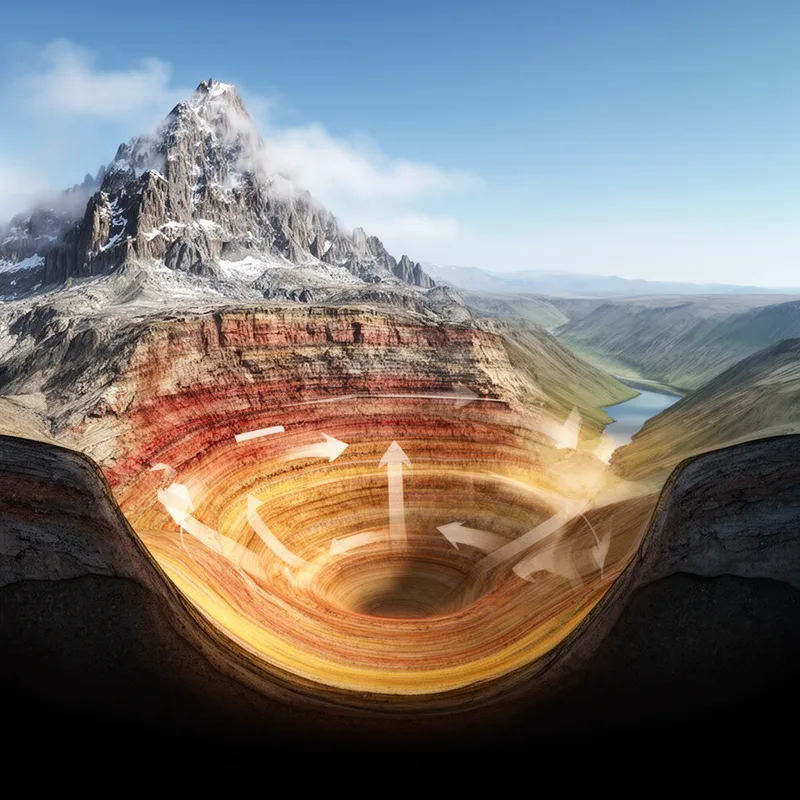
diastrophism
- noun
- /ˌdaɪəˈstrɒfɪzəm/
- Specialized
- Diastrophism is responsible for the uplift of mountain ranges over millions of years.
Examples
-
Many geological features, such as rift valleys, are shaped by diastrophism.
-
Scientists study diastrophism to understand the history and evolution of continents.
-
The theory of diastrophism explains how continents are formed.
-
Many geologists study diastrophism to understand Earth's structure.
-
Diastrophism is the process that shapes mountains and ocean basins over geological timescales.
-
Geologists explore how diastrophism leads to the formation of continents and various landforms.
-
Understanding diastrophism helps scientists explain the geological features of our planet.
Synonyms
 1
4.9
1
4.9

Movement of large parts of the Earth's outer layer that makes earthquakes or mountains

A process in which movements inside the Earth form and change the Earth's crust
Movement of the Earth's top rock layer that changes the land and causes earthquakes
Surface Forms
Morphology
diastrophism = dia + stroph + ism
The term is built from Greek combining forms and a technical suffix; its specialized geological meaning cannot be derived by a typical B1 learner from the parts alone.
Etymology
Diastrophism comes from Greek parts dia- meaning 'through' or 'across' and stroph meaning 'turn' or 'twist'. So, it names the large-scale twisting and movement of the Earth's crust that pushes up mountains and helps form ocean basins.