
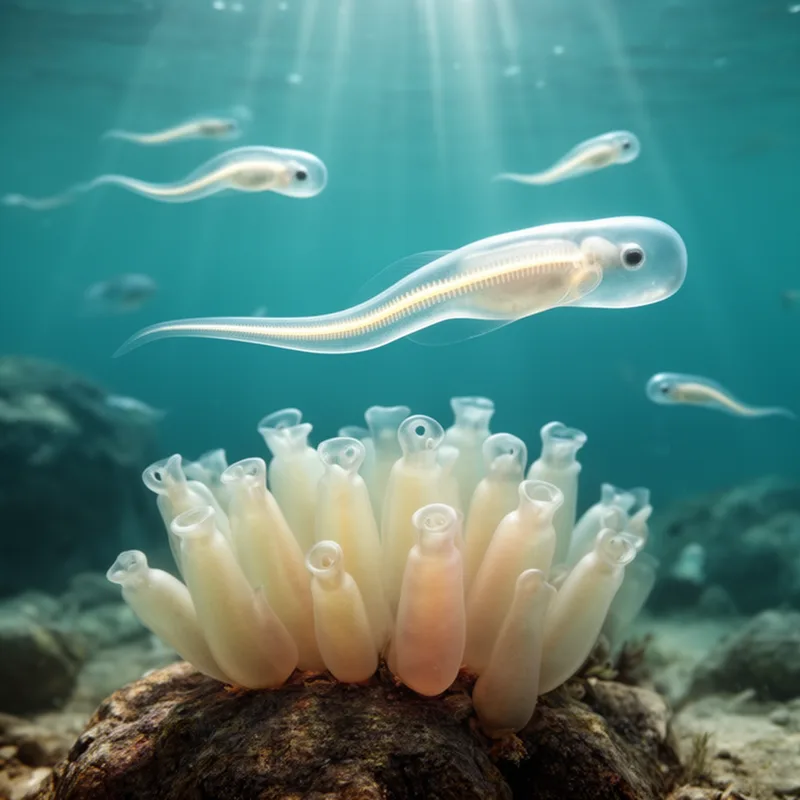
subphylum Urochorda
- noun
- /sʌbˈfaɪləm juˈroʊkɔrdə/
- Specialized
- Larvae in the subphylum Urochorda have a notochord that disappears as they mature.
Examples
-
Scientists study members of the subphylum Urochorda to learn more about chordate evolution.
-
The subphylum Urochorda includes various tunicates found in oceans around the world.
-
The subphylum Urochorda includes various species of tunicates.
-
Did you know that subphylum Urochorda contains sea squirts?
-
The subphylum Urochorda encompasses marine animals known as tunicates, which have a distinct sac-like body.
-
Research on the subphylum Urochorda is important for understanding the evolutionary history of vertebrates.
-
Organisms in the subphylum Urochorda exhibit a notochord at some developmental stage, crucial for their classification.
Synonyms

A group of sea animals like sea squirts with a bag-like body and a tail in the young stage

Sea animals that have bag-shaped bodies and a tough outer covering and that filter water to feed, like sea squirts
Sea animals with a sac-like body and a tough outer covering, like sea squirts
Sea animals with a sac-like body and a tough outer covering
Surface Forms
Morphology
The phrase is a straightforward taxonomic label: 'subphylum' denotes a subdivision of a phylum and 'Urochorda' names the group of sac-like marine animals. A B1 learner who knows both constituent meanings can infer this refers to the subgroup of chordates that comprises Urochorda (tunicates), so the meaning is directly compositional.
Etymology
Subphylum Urochorda The name subphylum Urochorda comes from the parts uro meaning 'tail' and chorda meaning 'cord'. Tunicate larvae have a stiff 'cord' in their tail, so the name points to that feature and shows this group is a 'subgroup' of chordates.

