
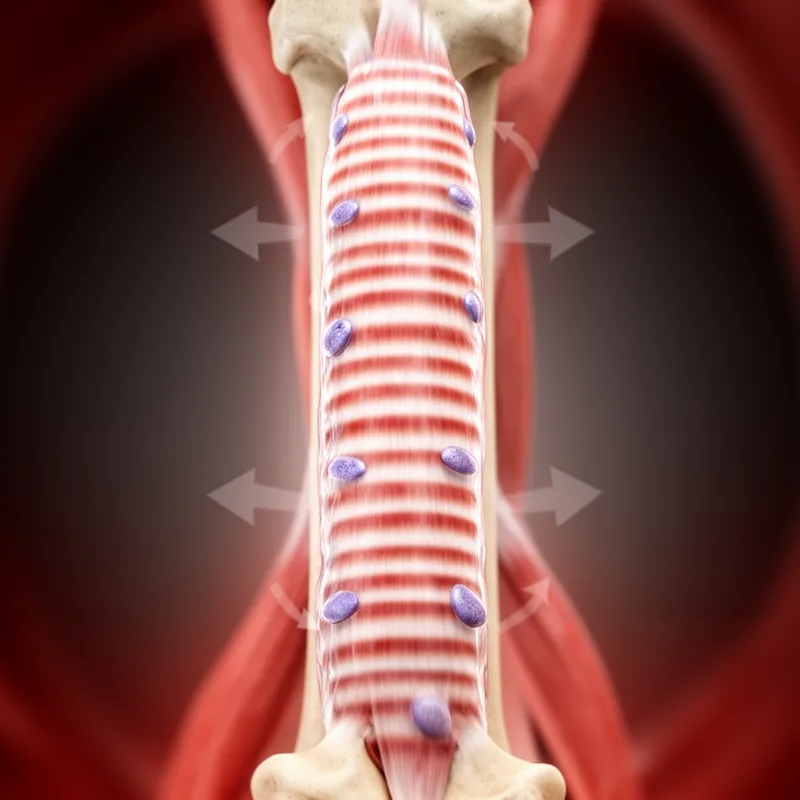
striated muscle cell
- noun
- /ˈstraɪ.eɪ.tɪd ˈmʌs.əl sɛl/
- Specialized
- The striated muscle cell enables controlled movements like running and lifting.
Examples
-
Muscle tissue is an extremely well-vascularized, aerobic tissue composed of parallel, non-branching striated muscle cells.
Academic text (1995) -
There is a major type of striated muscle cell that actually is innervated by the system that innervates the viscera.
-
Athletes develop strong striated muscle cells through regular training and exercise.
-
Each striated muscle cell works together with others to enable quick and powerful movements.
Synonyms

 4
3.4
4
3.4

A long cell in the body that gets shorter to make the body move
 2
8.0
2
8.0
A muscle cell that contracts to make parts of the body move

A long thin cell in striped muscles that can shorten to cause movement
Antonyms
- Specialized
A long thin cell that makes muscle in organs and blood vessels move without you controlling it
Surface Forms
Morphology
The meaning is compositionally derived from the parts: 'striated' (marked with parallel lines or striped) modifies 'muscle cell', so it denotes a muscle cell that has visible striations. This is a standard modifier+noun compound found across languages, so a B1 learner who knows the three constituent words can infer the basic meaning (though detailed biological properties are specialized).
Etymology
Striated muscle cell comes from the clear stripes you can see along a long muscle cell under a microscope; striated means 'striped' and muscle cell says it is a cell in muscle. Because these long, striped cells can contract to make the body move, the name refers to cells that make 'voluntary movement'.