

muscle fiber
 4
3.4
4
3.4

- noun
- /ˈmʌsəl ˈfaɪbər/
- Specialized
- When fatigued, muscle fibers have decreased capacity to absorb energy, which causes altered neuromuscular function.
- muscle fiber types
- recruit additional muscle fibers
- muscle fiber size
Loading YouTube…
Watch on YouTubeSo they're really just tearing those muscle fibers so that it can then grow.
- So they're really just tearing those muscle fibers so that it can then grow.
- Some people will be more susceptible to of this, to this, excuse me than others, but it does create more damage in muscle fibers.
- So we all agree and know today that we it's good to have a lot of muscle mass because there's a lot of mitochondria in the, in the muscle fibres.
- These spindle connections within the muscle that wrap around the muscle fibers sense the stretch of those muscle fibers.
- They can be quantified different ways histochemically, there's different ways to measure them, but there's slow twitch and fast twitch muscle fibers.
- They, they're not able to compact that tissue that we need for that muscle fibre formation.
- So they're just tiny little proteins, and they only live in the cells of your muscle fibers.
- The thing is, your muscle fibers have these little control centers all throughout them.
Examples
-
Each one of those muscle fibers can be broadly categorized as either fast twitch or slow twitch.
-
Those neurons then transmit the message into muscle fibers, which contract or relax in response, resulting in motion.
-
Your body has two types of muscle fibers and two main energy systems.
Blog text (25) -
Most people have a lot more type 1 muscle fibers in their legs.
Blog text (8) -
Muscle shaping here refers to the shape muscle fibers contract into so they can produce a desired action.
Academic text (2005) -
There are two types of muscle fibers: Type I, or slow twitch-oxidative red fibers, and Type II, fast twitch-glycolytic fibers.
Academic text (2005) -
At the large scale, this hamstring stretch is pulling on layers of protective tissue surrounding the muscle fibers, as well as the tendons that connect this muscle to nearby bones.
-
Athletes train hard to increase the number of muscle fibers they can engage during competition.
-
When you lift weights, tiny tears occur in your muscle fibers, leading to growth and strength improvements.
-
Different exercises can target specific types of muscle fibers, such as fast twitch for sprinting or slow twitch for endurance.
Synonyms
 3
3.0
3
3.0
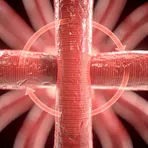
A long body cell that makes muscles move by becoming shorter and longer
 2
8.0
2
8.0
A muscle cell that contracts to make parts of the body move
How Big
- Specialized
1
3.9

- Specialized
679
1.3
- Specialized
4
3.4
Surface Forms
Morphology
The noun-noun compound 'muscle fiber' is directly compositional: a 'fiber' (an elongated, threadlike cell) that belongs to or composes 'muscle', so its meaning as a muscle cell/strand is directly derivable from the constituents. This is a common, cross-linguistic biomedical compounding pattern and would be immediately understandable to a B1 learner who knows both words.
Etymology
Muscle fiber comes from the image of a muscle being made of many long fibers like threads, where each tiny 'cell' can 'contract' or pull. So a muscle fiber is the long cell that pulls to make the whole muscle move.