

sawyer beetle
- noun
- /ˈsɔɪər ˈbiːtəl/
- US
- The fallen pine tree was infested with sawyer beetles boring deep into the wood.
Examples
-
The sawyer beetle is known for its destructive larvae.
-
After a wildfire, sawyer beetles often colonize the scorched trees, hastening their decay.
-
Researchers studied the life cycle of a sawyer beetle found in North American forests.
-
Many sawyer beetles thrive in dead trees.
-
The fallen pine tree was infested with sawyer beetles boring deep into the wood.
-
After a wildfire, sawyer beetles often colonize the scorched trees, hastening their decay.
-
Researchers studied the life cycle of a sawyer beetle found in North American forests.
Synonyms

 3
8.1
3
8.1

An insect or larva that makes holes in wood and damages trees

A beetle whose young make holes in dead or dying trees
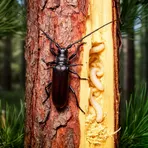
A large longhorn beetle whose young tunnel into pine trees
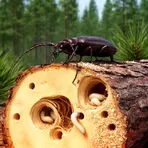
A large beetle whose young bore holes in pine trees
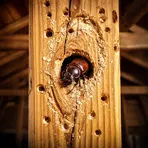
An insect or small animal like a beetle that makes holes in wood and damages it

A large black-and-white beetle from Asia that attacks and kills trees like maple and oak
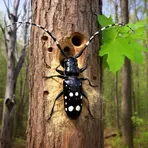
A large beetle from eastern Asia that attacks and kills hardwood trees like maple or oak
Surface Forms
Morphology
The noun phrase is fully compositional: the modifier 'sawyer' specifies the kind of 'beetle', so a learner who knows both constituent meanings can infer this is a beetle of the sawyer type (i.e., a longhorn beetle whose larvae bore into dead trees). This modifier+head compounding pattern is a standard, cross-linguistic way to form names of animals and is therefore immediately interpretable by B1 learners who know the parts.
Etymology
Sawyer beetle comes from the old word sawyer, a person who 'saws' wood, because the beetle's young chew and bore into trees like tiny saws. So the name explains why it refers to a large beetle whose young live in dead or dying trees.