

rubbly
- adjective
- /ˈrʌbli/
 :
rocoso
:
rocoso
- rubbly steep
Examples
-
The point I'd marked in my head, shit, it wasn't there, just this huge field of rubbly snow, heavy as wet cement.
Fiction book (1996) -
With six picked soldiers of his company, Don Kishote went edging along the south ridge on a narrow outcrop, where poor rubbly footing and deep drops on either side made for slow going, toward an emplacement that was pouring out bright noisy volleys.
Fiction book (1993) -
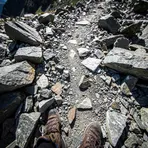
The hiker carefully stepped over the rubbly terrain, trying not to lose his balance.
-
Driving along the rubbly path made for a bumpy ride, but the views were worth it.
-
They navigated the rubbly hillside with caution, as loose stones could easily cause a fall.
Synonyms
 63
1.0
63
1.0

Land that has many rocks or stones
 31
3.7
31
3.7
Land with a rough, uneven surface covered in rocks
 7
2.7
7
2.7
Ground that is full of rocks
 1
3.9
1
3.9
Covered with many small stones that crunch underfoot
 1
3.2
1
3.2
Covered with many small round stones
 1
4.6
1
4.6
A surface covered in many small round bumps like tiny stones

 1
9.9
1
9.9
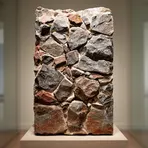
Rock made of many large broken pieces

Rock that is made of loose small pieces like sand

A surface covered with small stones or pebbles

A street or path covered with round stones that is hard to walk on
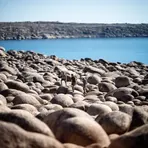
A place that is covered with many large rounded rocks

Having many large rocks on the surface
How Rocky

Surface Forms
Morphology
Etymology
Rubbly comes from rubble, a word for loose, broken stones, plus the ending -y meaning 'full of' or 'covered with'. So a rubbly place is 'full of rubble', like a path covered in small stones after a landslide.