

stony
 7
2.7
7
2.7

- adjective
- /ˈstoʊni/
- Both islands were steep and stony, surrounded by rocks and shoals.
- stony meteorite
- stony chondrite
- stony hill
Loading YouTube…
Watch on YouTubeNo tree or thorn or blade of grass grew in the Stony earth under the unsetting stars.
- No tree or thorn or blade of grass grew in the Stony earth under the unsetting stars.
Examples
-
No tree or thorn or blade of grass grew in the Stony earth under the unsetting stars.
-
Tree roots, wildly splayed over the stony ground, seemed to quicken and quiver in the dim light.
Fiction book (2001) -
Off to the west, he had noticed a stony gray island that seemed more substantial than the rest.
Fiction book (1994) -
England, Africa, California; stony islands alive with seals; the coast of Florida.
Fiction book (1999) -
I followed her down the stony path and then up the pine-covered hill to the stream.
Fiction book (1994) -
The dining hall had a stony floor, and the walls and ceiling were of rough unfinished rock.
Fiction book (2001) -
Cabin one rested on a stony hill overlooking the black shore of the lake.
Fiction book (1991) -
The region's soil is mostly too stony for cultivation, but it is suitable for cattle ranching.
-
Tree roots, wildly splayed over the stony ground, seemed to quicken and quiver in the dim light.
-
Green slopes on either side rise to stony mountaintops flecked with snow even on the hottest days.
Synonyms
 63
1.0
63
1.0
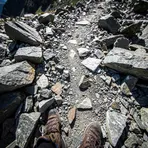
Land that has many rocks or stones
 31
3.7
31
3.7
Land with a rough, uneven surface covered in rocks
 1
3.2
1
3.2
Covered with many small round stones
 1
3.9
1
3.9
Covered with many small stones that crunch underfoot
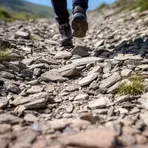
Covered with loose stones and broken pieces of rock

A surface covered with small stones or pebbles

A street or path covered with round stones that is hard to walk on
Antonyms


Compounds




How Stony

Surface Forms
Morphology
Etymology
Stony comes from the old English word stone plus the ending -y, where -y means 'full of'. So stony literally meant 'full of stones', which is why we use it for land or ground covered in rocks.