

red giant star
 1
6.3
1
6.3

- noun
- /rɛd ˈdʒaɪənt stɑr/
- Specialized
- In about 5 billion years, the sun will expand into a red giant star, engulfing Mercury, Venus, and Earth as it grows.
Examples
-
Much of his research centers around old red-giant stars and globular clusters in the Milky Way.
Academic text (2004) -
Aldebaran, the bull's flaming red eye we now know is an ageing red giant star that's forging carbon, oxygen and nitrogen inside it.
-
The element carbon is made in old red giant stars through the fusion of helium.
Academic text (2004) -
For reasons not yet fully understood, technetium lives in the atmospheres of some red giant stars.
Academic text (2002) -
Still, Cetus does boast one of the brightest red-giant stars in the heavens.
Blog text (14) -
The planet-eating culprit, a red-giant star named BD+48 740, is older than the Sun and now has a radius about eleven times bigger than our Sun.
Blog text (30) -
The element carbon is made in old red giant stars through the fusion of helium.
-
A planetary nebula's formation begins with an aging red-giant star.
Synonyms
 27
8.8
27
8.8
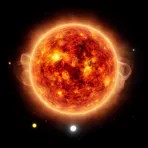
A very large bright star near the end of its life
 7
7.2
7
7.2
A very large old star with a cool surface and much larger size than the Sun
 3
6.8
3
6.8
A very large bright star near the end of its life
How Big
- Specialized
3
8.5

- Specialized
1
6.3
- Specialized
3
6.8
- Specialized
- Specialized
5
7.5
Surface Forms
Morphology
The meaning is directly compositional: 'red' (a color) + 'giant' (very large) + 'star' (luminous celestial object) yields the straightforward description 'a very large reddish star.' This descriptive, adjective+noun combination follows ordinary English composition and is cross-linguistically transparent, so a B1 learner who knows the constituents can infer the meaning.
Etymology
The term red giant star shows a clear picture: when a star runs out of hydrogen it swells up and its surface cools, so it shines red and becomes very giant. So the name means a large, reddish star in the later part of its life.