

giant star
 3
6.8
3
6.8

- noun
- /ˈdʒaɪənt stɑr/
- Specialized
- It is thought that most elements heavier than silicon form during giant star explosions known as supernovae.
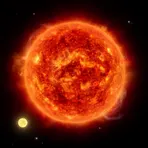
- a red giant star
- an explosion of a giant star
Loading YouTube…
Watch on YouTubeWe couldn't see what was causing it, but the gases of the blue giant star were being funneled into an invisible companion and it created a Halo.
- We couldn't see what was causing it, but the gases of the blue giant star were being funneled into an invisible companion and it created a Halo.
- So for a very Big Blue super giant star, it takes months before the quake went up and down.
Examples
-
Both newborn stars and dying giant stars give clear indications of their age.
-
Planetary nebulae, formed when giant stars throw off their outer layers as they age, are another kind of object that has been recognized in M31.
Academic text (1993) -
The element carbon is made in old red giant stars through the fusion of helium.
Academic text (2004) -
Want to watch the explosion of a giant star, whose mass is as great as forty suns?
Academic text (2006) -
For reasons not yet fully understood, technetium lives in the atmospheres of some red giant stars.
Academic text (2002) -
Much of his research centers around old red-giant stars and globular clusters in the Milky Way.
Academic text (2004) -
Aldebaran, the bull's flaming red eye we now know is an ageing red giant star that's forging carbon, oxygen and nitrogen inside it.
-
When stars run out of hydrogen fuel, they swell into bloated giant stars and explode, hurling their atmospheres into space and leaving behind a glowing core of carbon and oxygen.
Academic text (1996) -
The element carbon is made in old red giant stars through the fusion of helium.
-
Scientists expect more than 90 percent of these sources to be red giant stars.
Synonyms
 27
8.8
27
8.8
A very large bright star near the end of its life
 7
7.2
7
7.2
A very large old star with a cool surface and much larger size than the Sun
 3
8.5
3
8.5
A very large, bright star much larger than the Sun near the end of its life
 1
6.3
1
6.3
A very large, old star that shines bright and red


 1
9.6
1
9.6
A very large, very bright star much larger than a supergiant
How Big

Surface Forms
Morphology
The meaning is directly compositional: 'giant' (very large) combined with 'star' (a luminous celestial body) yields a large/very luminous star. This is a straightforward, cross-linguistically common noun+modifier pattern using frequent words, so a B1 learner who knows both constituents will readily infer the intended meaning (even if the term can also refer specifically to a stellar class).
Etymology
Giant star comes from the simple picture of a star that has grown very large and bright. When a star grows bigger near the end of its life it can look like a huge light in the sky, so people put giant and star together to mean a star that is 'very big' and 'very bright'.