

red dwarf
 3
6.4
3
6.4

- noun
- /rɛd dwɔrf/
- Specialized
- The future portion of the Stelliferous Era belongs to the low-mass stars known as red dwarfs, by far the most common stars.
- red dwarf star
Loading YouTube…
Watch on YouTubeAnd these are planets orbiting small red dwarf stars.
- And these are planets orbiting small red dwarf stars.
- It is not a nice place to be living during that time for red dwarfs that that adolescence extends for a billion years in some cases.
- So no, no red dwarf stars have ever died.
Examples
-
The Butler-Marcy team studied Gliese 436 with the 10-m Keck Telescope on Mauna Kea as part of a systematic survey of red dwarfs.
Academic text (2004) -
Proxima Centauri is an M5.5Ve star, or a cool red dwarf with emission lines.
Academic text (2005) -
So no, no red dwarf stars have ever died.
-
One interesting result revealed in the new data is the large number of faint red dwarf stars.
Blog text (14) -
If our models of this planet and red dwarf star are correct, the transit depth should be about 1.7%.
Academic text (2007) -
Without knowledge of the basic physical properties of red dwarf stars, how can we hope to understand the planets that orbit them?
-
Although they contain less than half the mass of the Sun, red dwarfs are so numerous that their combined mass easily exceeds that of all the larger stars in the Universe.
Academic text (2000) -
In some respects, searching for planets around red dwarfs is harder than around heavier, hotter stars.
Academic text (2004) -
Orbiting only 0.028 AU from the red dwarf, the planet is so close that tidal coupling may well have locked its rotational period to its orbit.
Academic text (2004) -
The red dwarf star has a much lower temperature than our Sun, making it less bright.
Synonyms
 1
6.7
1
6.7
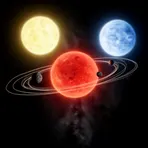
A small, cool star that shines red and lives for a very long time
How Bright

Surface Forms
Morphology
red + dwarf
A learner who knows 'red' (a color) and 'dwarf' (a small person/thing) can plausibly infer 'red dwarf' refers to a small, red-type star, so the core idea is recoverable from the parts. However, the precise technical senses (that it is a low-mass, relatively cool, long-lived star) are specialized and not fully predictable from the constituents alone, and 'dwarf' in the astronomical sense is a domain-specific extension, so the expression is only partially transparent.
Etymology
Red dwarf simply names the star's colour and size: red because it glows red and is cooler, and dwarf because it is much smaller than the Sun. So, the name means a 'small', 'cool' star that is not very bright and can live for a very long time.