

to ravel out
- phrasal verb
- /ˈrævəl aʊt/
 :
desenredar
:
desenredar
- It took hours to ravel out the tangled cords behind the television.
Examples
-
She tried to ravel out the threads of the old sweater.
-
The detective worked tirelessly to ravel out the clues of the case.
-
Can you ravel out this knot?
-
She is trying to ravel out the details of the case.
-
It took hours to ravel out the tangled cords behind the television.
-
She tried to ravel out the threads of the old sweater.
-
The detective worked tirelessly to ravel out the clues of the case.
Synonyms

 75
4.4
75
4.4

To find out what really happened in a confusing situation
 10
3.5
10
3.5
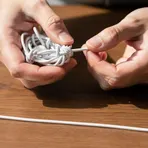
To separate threads or cords that are twisted together
 1
5.3
1
5.3
To free something twisted and knotted, like a cord


 1
7.6
1
7.6
To free something from a tangle, like knots in rope or wire
 1
7.4
1
7.4
To separate things that are twisted together, like cables or yarn
 1
5.1
1
5.1
To make a tied rope or string loose so it comes apart

To untangle threads or cords that are twisted together

To free a person or thing from a difficult situation
Antonyms

How Untangled

Surface Forms
Morphology
The MWE's meaning is directly built from 'ravel' (to disentangle) plus the particle 'out' which signals separation or completion; together they yield a straightforward compositional sense of disentangling or working something out. This verb+out pattern is a common, predictable English construction, so a B1 learner who knows both constituents would readily infer the MWE meaning.
Etymology
Ravel out comes from the image of untangling cloth: to ravel is to pull tangled threads loose and out shows moving them away. So it means 'to untangle' or 'to make a confusing thing clear'.