
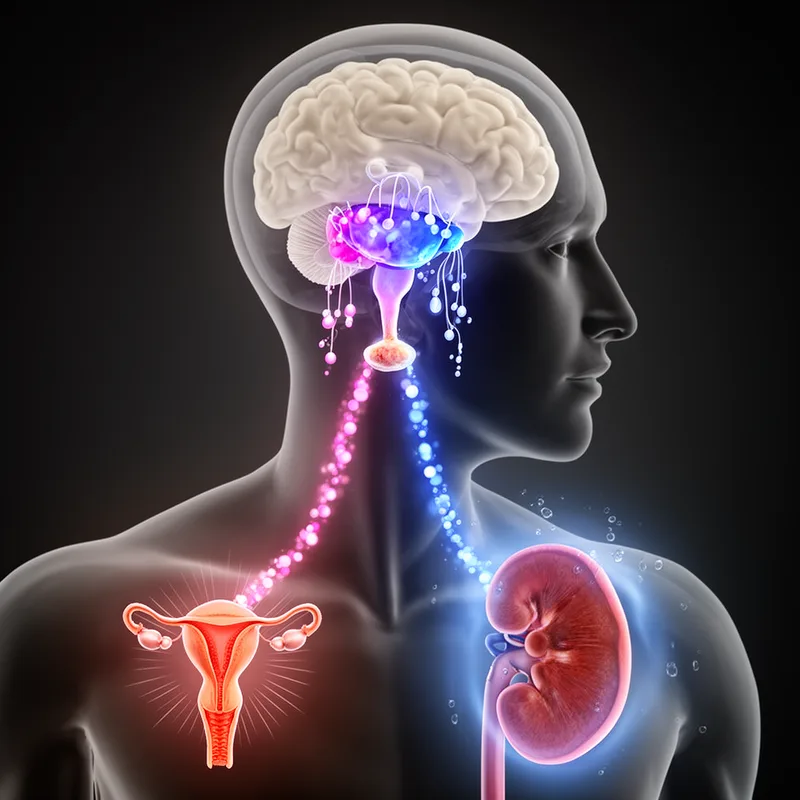
posterior pituitary gland
- noun
- /ˌpoʊstɪˈɪəriər pɪˈtjuːɪtəri ɡlænd/
- Specialized
- The posterior pituitary gland stores and releases oxytocin and vasopressin produced by the hypothalamus.
Examples
-
Hormones released by the posterior pituitary gland play a crucial role in water balance and childbirth.
-
Injury to the posterior pituitary gland can lead to disorders like diabetes insipidus.
-
The posterior pituitary gland releases hormones into the bloodstream.
-
What is the function of the posterior pituitary gland?
-
Hormones released by the posterior pituitary gland play a crucial role in water balance and childbirth.
-
Injury to the posterior pituitary gland can lead to disorders like diabetes insipidus.
-
The posterior pituitary gland stores and releases oxytocin and vasopressin produced by the hypothalamus.
Synonyms

The back part of the small gland at the base of the brain that sends hormones to control body water
The back part of the pituitary gland that stores and releases hormones made in the brain into the blood
The back part of the pituitary gland that stores and releases hormones made in the brain
Surface Forms
Morphology
This term is compositionally built from 'posterior' (rear) + 'pituitary' (the endocrine gland) + 'gland' (organ that releases hormones), so the meaning 'the rear part of the pituitary gland' is directly derivable from the parts. It follows standard anatomical naming patterns common across languages, so a B1 learner who knows the constituent words will be able to infer the MWE's meaning.
Etymology
Posterior pituitary gland names the posterior part, meaning the 'back', of the small pituitary gland at the base of the brain. It stores and then releases hormones like oxytocin and vasopressin into the blood, so it 'sends out' chemical signals that control water balance and childbirth.

