

polynucleotide
- noun
- /ˌpɒlɪˈnjuːklɪˌtaɪd/
- Specialized
- In 1973, he published "A Theory of Marginotomy: The Incomplete Copying of Template Margin in Enzymatic Synthesis of Polynucleotides and Biological Significance of the Phenomenon" in the Journal of Theoretical Biology.
Examples
-
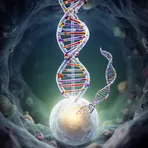
A polynucleotide, made of linked nucleotide units, forms the backbone of a DNA molecule.
-
So you made somehow an anti sense polynucleotide to the insulin gene or some fraction of the insulin gene?
-
RING-FISH employs multilabeled polynucleotide probes that organize themselves into large networks around the target (Zwirglmaier 2005).
Academic text (2008) -
Researchers study how polynucleotides, like RNA, play a crucial role in protein synthesis.
-
In the laboratory, scientists can create a synthetic polynucleotide to replicate natural processes.
Synonyms
 3
4.6
3
4.6

A long molecule like DNA or RNA that stores genetic information in cells
 1
4.2
1
4.2
A long molecule in cells that carries information about how living things grow and look
 1
9.9
1
9.9
A short piece of DNA or RNA used in genetic tests and research
How Long

Surface Forms
Morphology
polynucleotide = nucleotide (semi-transparent) = poly + nucleotide
The meaning is clear from 'poly-' meaning 'many' plus 'nucleotide', but the term is specialized scientific vocabulary rather than everyday English.
Etymology
Polynucleotide comes from the prefix poly- meaning 'many' and nucleotide, the name for a small 'building block' of DNA and RNA, so a polynucleotide is a long chain made of many nucleotides, like DNA and RNA.