
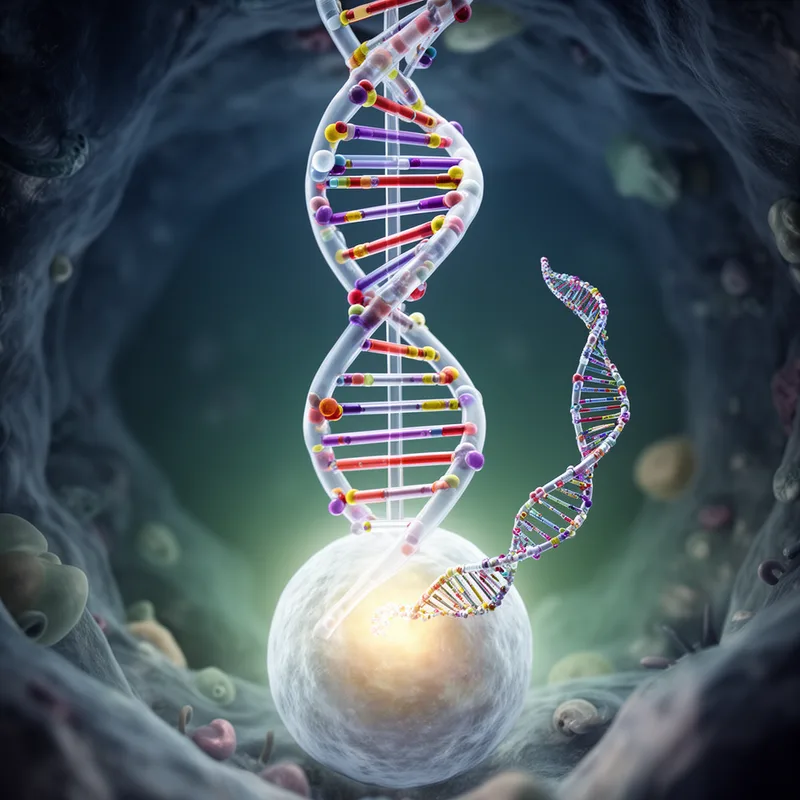
nucleic acid
 3
4.6
3
4.6

- noun
- /njuˈkleɪɪk ˈæsɪd/
- Specialized
- As readers might recall, PCR is a method to amplify nucleic acid sequences, like those of DNA or RNA.
- nucleic acid sequence
- nucleic acid amplification
- nucleic acid hybridization
Loading YouTube…
Watch on YouTubeLet's write a small piece of nucleic acid and then turn it into protein.
- Let's write a small piece of nucleic acid and then turn it into protein.
- Both of these nucleic acid vaccine companies built their vaccine from scratch once they downloaded the genetic sequence for this new virus.
- And now we have to think about principles are based at least on Earth, on nucleic acids.
Examples
-
Researchers are exploring the role of nucleic acid in the inheritance of traits.
-
Let's write a small piece of nucleic acid and then turn it into protein.
-
And so we're going to talk about both of those nucleic acids and proteins.
-
Its arguments will need to be taken into account in further modeling of nucleic acid evolution.
Blog text (25) -
DNA stores information in four types of nucleotides, making them nucleic acids, not proteins.
Blog text (10) -
And what's more, magnesium ions are required for nucleic acids like RNA to function.
-
Both of these nucleic acid vaccine companies built their vaccine from scratch once they downloaded the genetic sequence for this new virus.
-
Nucleic acid hybridization studies indicated that ribosomal RNA has a relatively slow rate of mutation.
Academic text (2004) -
Nucleic acids, such as nucleic acid, carry genetic information in all living organisms.
-
Nucleic acids are essential for the production of proteins and the functioning of cells.
Synonyms
A long chain of small parts that form DNA or RNA
Surface Forms
Morphology
nucleic + acid
The compound is a straightforward technical composition: 'nucleic' (pertaining to the nucleus) + 'acid' (a chemical substance) yields an acid related to the cell nucleus (i.e., DNA/RNA). This formation is compositional and mirrored across many languages (e.g. Spanish 'ácido nucleico'), so a learner who knows both constituents can infer the intended biological meaning.
Etymology
Nucleic acid comes from a simple lab story: a scientist found an acidic substance inside the cell 'nucleus' and named it nucleic from the word 'nucleus' and acid because it was acidic. That's why the name means 'acid from the nucleus' and today it refers to DNA and RNA that store the genetic instructions of living things.