
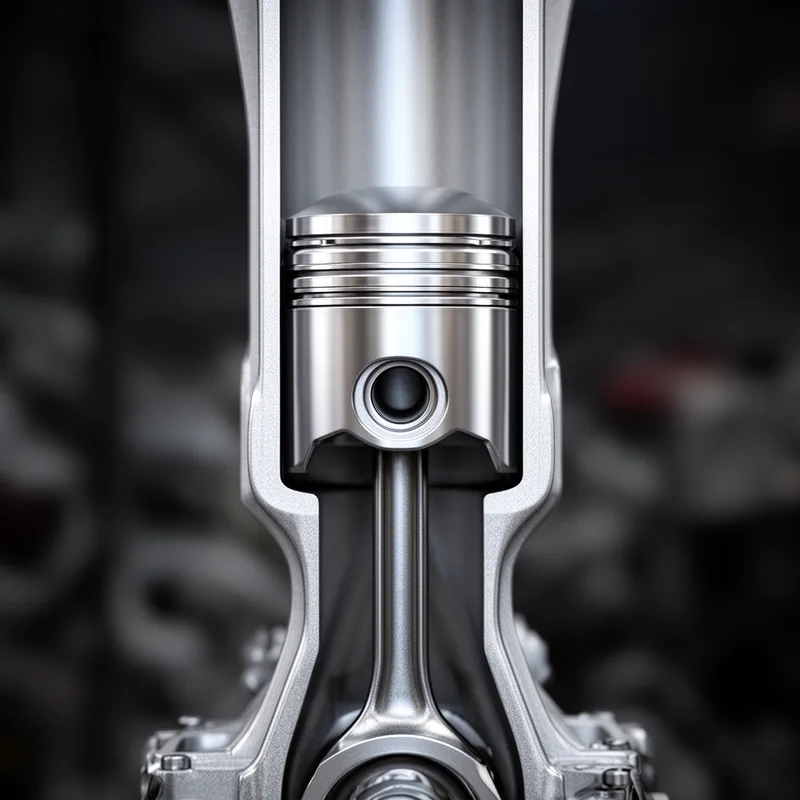
piston
 57
4.1
57
4.1

- noun
- /ˈpɪstən/
- Specialized
- As the piston moves up, it compresses the air and fuel mixture inside the cylinder.
- piston engine
- piston inside the cylinder
- piston rod
Loading YouTube…
Watch on YouTubeIt has a piston inside that drives this back and forth.
- It has a piston inside that drives this back and forth.
Examples
-
We show you this little map of the braking system with all the parts like the piston, the brake shoe, the brake drum.
-
Then, as the piston rises, this air and fuel mixture is compressed.
-
So, and we'll focus on the work done by the piston on the gas.
-
You know, this is an air spring, so it's like a piston with air inside.
-
The expanding hot gases push the piston back down.
-
It has a piston inside that drives this back and forth.
-
Early piston engines were a marvel of ingenuity and simplicity.
-
Though the process is proprietary, company president Francis Schwind said that C-CAT's piston manufacturing costs are coming down.
Academic text (1995) -
Taylor, a car racing enthusiast, was well acquainted with the common phenomenon of piston failure in high-performance engines.
Academic text (1995) -
In a gasoline engine, the fuel is mixed with air, compressed by Pistons, and ignited by sparks from spark plugs.
Compounds

- Specialized

 1
5.3
1
5.3
A space in an engine or pump where a piston moves to push and squeeze liquids and gases
- Specialized
1
6.0
A thin metal band that fits around a piston to stop gas and oil leaking past it

How Fast
- Specialized
1
9.9

- Specialized
1
9.4
- Specialized
1
5.7
- Specialized
3
6.9
- Specialized
57
4.1
Surface Forms
Etymology
The word piston comes from an old Latin verb pistare meaning 'to pound' or 'to press'. Think of a pestle that pounds in a bowl: a piston moves up and down inside a cylinder to push or squeeze gas or liquid, which is why we use the word for that engine or pump part.