
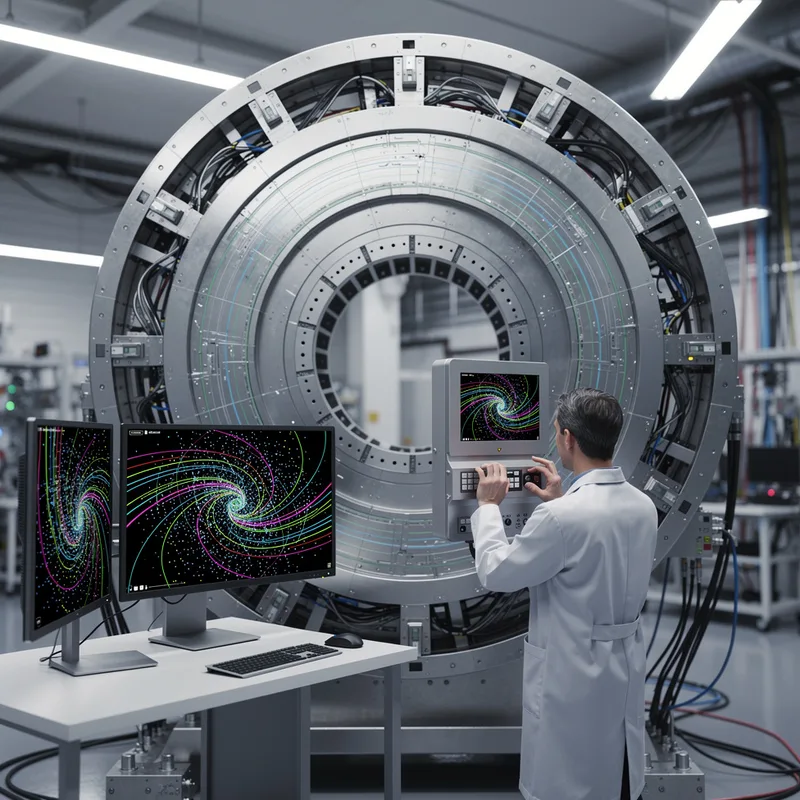
particle detector
 1
5.8
1
5.8

- noun
- /ˈpɑrtɪkl dɪˈtɛktər/
- Specialized
- At the research facility, scientists use a particle detector to identify the traces left by subatomic particles.
Examples
-
Particle detectors at hadron colliders have evolved in size and complexity as technology has advanced and physics questions have changed.
Academic text (2012) -
Another dozen orbiters detected the pulse with particle detectors activated by the sudden flood of high-energy photons.
Academic text (2006) -
So instead with gamma rays, what we've done is this is basically a particle detector, but in space.
-
But that was not the only new technology; we also used one of the first large-solid-angle particle detectors (Figure 4).
Academic text (1997) -
Experimenters set up particle detectors at eight points where the two counter-circulating beams crossed each other.
Academic text (2012) -
This has to be contrasted with the challenge to deploy a rather sophisticated particle detector through the waves and operate it continuously in the deep ocean currents under high pressure.
Academic text (2000) -
All four instruments have a plastic outer particle detector, called an anticoincidence counter, that records cosmic rays and other charged particles by giving off a signal different from that produced by gamma rays.
Academic text (1990) -
Though designed primarily to detect gamma-ray photons, the LAT is inherently a charged-particle detector.
Academic text (2012) -
Figure 2 shows an unsaturated record of the spike, made by a particle detector aboard Geotail, a Japanese orbiter that studies Earth's magnetosphere.
Academic text (2006) -
Da Silva had to pick up three particle detectors, recently fabricated by the manufacturer ORTEC, and get them back to the Center for Particle Astrophysics, her employer in Berkeley, California, as quickly as possible.
Academic text (1993)
Synonyms
 189
3.5
189
3.5
A device that senses things like metal, movement, or radioactivity
 7
4.8
7
4.8
A device that detects and measures invisible radiation from radioactive materials
A device that makes sparks to show paths of tiny charged particles

A material that gives light when hit by X-rays to detect radiation
Device that measures radiation that makes charged particles by detecting those particles in a gas

A machine that detects radiation in the body to make images showing how organs work
How Sensitive
- Archaic

 1
7.8
1
7.8

- Specialized
1
7.5
- Specialized
1
5.8
- Specialized
7
4.8
Surface Forms
Morphology
The meaning is directly compositional: a 'detector' is an instrument that detects and 'particle' names small physical bits, so a B1 learner who knows both words can infer 'an instrument that detects particles.' This noun-noun compound follows a common, cross-linguistic pattern (headed by 'detector'), making the sense predictable and transparent.
Etymology
Particle detector comes from old lab devices where tiny particles moved through a special chamber and left visible tracks that the detector could show. So the name means 'a device that finds and shows tiny particles', which is why we use it for instruments that reveal invisible particles.