

bubble chamber


 1
7.8
1
7.8
- noun
- /ˈbʌbəl ˈtʃeɪmbər/
- Archaic
- The effect was soon verified, and before the end of the decade, Joseph Ballam and collaborators at SLAC were using a low-intensity backscattered gamma beam in bubble-chamber experiments.
- hydrogen bubble chamber
Examples
-
Using a bubble chamber, researchers were able to track the movement of electrons with remarkable precision.
-
The scientists observed the particle collisions in the bubble chamber as tiny bubbles indicated the paths taken by the ionizing particles.
-
By the 1970s, most of these problems had been overcome, and large superconducting coils for bubble chambers were a reality.
Academic text (1993) -
Tight spirals in the frame are due to electrons whose trajectories are curved by the bubble chamber's magnetic field.
Academic text (2004) -
The "skid marks" are trails of tiny bubbles, which charged particles create as they screech through the liquid hydrogen in a bubble chamber.
Academic text (1996) -
To look for uncharged tachyons, Feinberg and his Columbia colleagues studied the particle trails in 6,000 bubble-chamber photos (see photo on p. 12).
Academic text (1996) -
In the bubble chamber, the trails of bubbles revealed how the charged particles interacted with the superheated liquid.
Synonyms
 1
5.8
1
5.8
A machine that finds and shows very small particles inside atoms in physics experiments
 1
7.5
1
7.5
A device that shows the paths of tiny invisible particles as thin white streaks in a mist
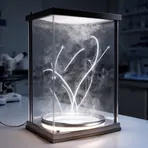
A device that makes vapor tracks to show where tiny charged particles move
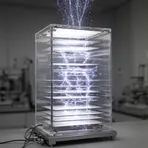
A device that makes sparks to show paths of tiny charged particles
How Detailed
- Archaic
1
7.8

- Specialized
1
7.5
- Specialized
1
9.0
- Specialized
- Specialized
7
4.8
Surface Forms
Morphology
The compound is transparently built from 'bubble' (gas pockets) + 'chamber' (enclosed space), so a learner can infer it denotes a chamber involving bubbles. Although it names a technical physics device, the basic purpose—a space where bubbles are observed—is directly derivable from the constituents and cross-linguistically plausible.
Etymology
Bubble chamber comes from the simple image of bubbles forming in a clear chamber of liquid. One popular story says the inventor saw bubbles in a glass and imagined a device where moving particles would leave lines of bubbles, so the name fits because it uses 'bubbles' to 'show' particle 'paths'.