
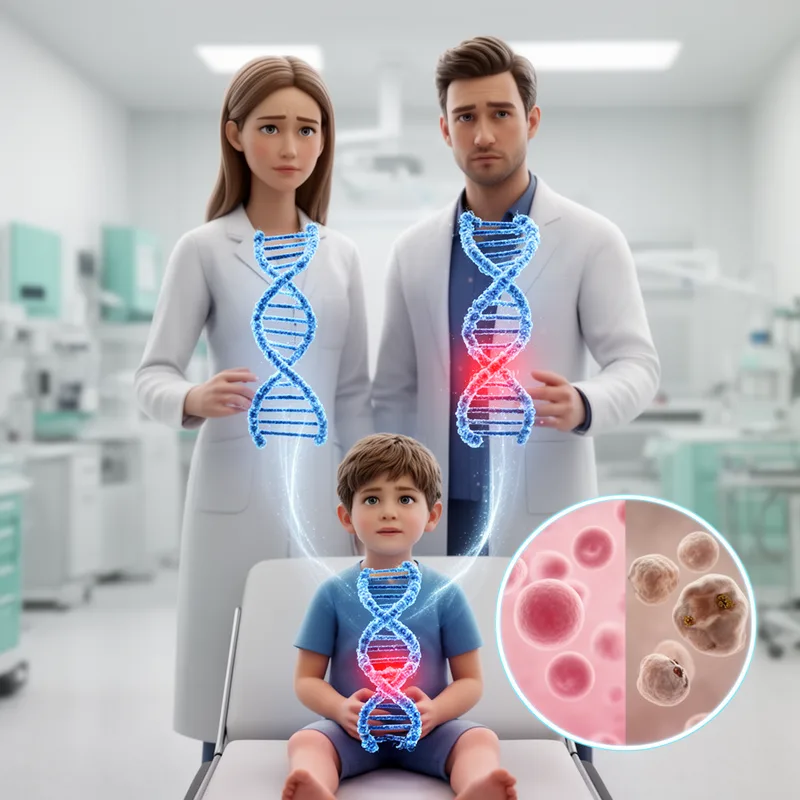
monogenic disorder
- noun
- /ˌmɒnəˈdʒɛnɪk dɪsˈɔːrdər/
- Specialized
 :
trastorno monogénico
:
trastorno monogénico
- Scientists are working to develop treatments for various monogenic disorders that have been linked to specific gene mutations.
Examples
-
Cystic fibrosis is a common example of a monogenic disorder that affects the lungs and digestive system.
-
Thus, the number of monogenic disorders is expected to increase.
Academic text (2004) -
Understanding how monogenic disorders are inherited can help families assess their risk of passing on genetic conditions.
Synonyms

 9
4.2
9
4.2

A health problem caused by changes in a person's genes that parents pass on
 3
4.6
3
4.6
A change in a person's genes that causes a disease


 1
4.2
1
4.2
A disease parents pass to their children in their genes

A disease caused by a change in a single gene that a person inherits
Antonyms

- Specialized
An inherited disease caused by many genes, for example high blood pressure or type 2 diabetes
How Polygenic
- Specialized

- Specialized
Surface Forms
Morphology
The phrase combines 'monogenic' (caused by a single gene) with 'disorder' (a medical/health condition), so its meaning — a disorder caused by a single gene — is directly and compositionally derivable from the parts. This is a regular scientific compound following predictable morphology and cross-linguistic patterns, making it transparent to a learner who knows the constituent words.
Etymology
The term monogenic disorder comes from the parts mono- meaning 'one' and -genic meaning 'from a gene', with 'disorder' for a health problem. Think of one broken brick in a wall: that single faulty gene can cause the whole illness, so the phrase means a disease caused by a change in one gene.