

to leave office
 53
4.2
53
4.2

- phrasal verb
- Literature
- The mayor is planning to leave office at the end of his term to pursue other opportunities.
- members leave office
- presidents leave office
- justices leave office
Loading YouTube…
Watch on YouTubeAnd then they leave office and they're just regular people again.
- And then they leave office and they're just regular people again.
- Because you don't want to become that country where as soon as somebody leaves office, they prosecute them.
- They're issuing them, you know, maybe once every two years and mostly at the end when they're leaving office.
- Both Henry Kissinger and Robert McNamara said after leaving office that they would not have done it.
- Yesterday, when reporters asked if Trump would leave office if the Electoral College votes for Joe Biden, Trump said certainly I will.
- I did get to look at she and say, OK, is he going to leave office without doing that or does he want that as his key legacy?
- Iran broke when when Trump left office.
- Well, first of all, America's changed drastically since we left office.
- The state police gave me a revolver as a sort of a collectible when I left office.
Examples
-
House members have become less active in recent years, including those who have left office.
Academic text (2004) -
Since Roosevelt, the only presidents to leave office with high approval ratings have been Eisenhower and Reagan.
Academic text (1991) -
But that he would be glad to accept it once he left office...
-
But for the purpose of this conversation, you know, let's say that he is going to leave office when his term is up.
-
Shortly after leaving office, he was offered a business arrangement that might have made him rich.
Academic text (1993) -
On average, fifty-two House members leave office during each Congress.
Academic text (2004) -
The president who appointed Kirkwood, William M. Daily, left office under a cloud.
Academic text (2000) -
There was a budget surplus when Clinton left office and when Bush entered office.
Blog text (8) -
Biden will leave office with half his priorities unmet, right?
-
However, the real sea change in the public perception of the CIA came after Nixon left office.
Academic text (2009)
Synonyms
 788
1.2
788
1.2
To leave a job or position
 533
3.7
533
3.7
Leave a job or office by giving notice
 176
1.3
176
1.3
To leave a place to start a journey
 148
3.3
148
3.3
Give up an important job so someone else can take over
 123
5.1
123
5.1
To stop doing a job, duty or action after someone tells you to
 82
2.6
82
2.6
Make someone leave their job, often because of age or a serious event
 52
4.5
52
4.5
Leave a place or job so it is free for someone else
 23
8.0
23
8.0
To give up a position of power, for example a king or queen
 20
4.9
20
4.9
To stop doing a job or role politely
 6
2.5
6
2.5
To stop working at a job because you want something different
To officially give up power, rights, or a position

To stop working after a long time

To stop working in your job, especially as an athlete
Antonyms


How Official
31
7.4
 874
2.0
874
2.0
- Literature
53
4.2
- Formal
533
3.7
24
2.2
Surface Forms
Morphology
The meaning 'to give up or retire from a position' is directly compositional from 'leave' (to depart/quit) + 'office' (an official post), so a B1 learner who knows both words can infer the sense of departing from a role. While there can be surface ambiguity with physically leaving an office space, the institutional/political sense is a straightforward, cross-linguistically common combination and therefore transparent.
Etymology
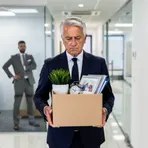
Leave office paints a simple picture: a leader packs a box of papers, walks out of their office, and hands in keys as they leave for the last time. So, it now means 'to give up or retire from a position of authority or responsibility'.