
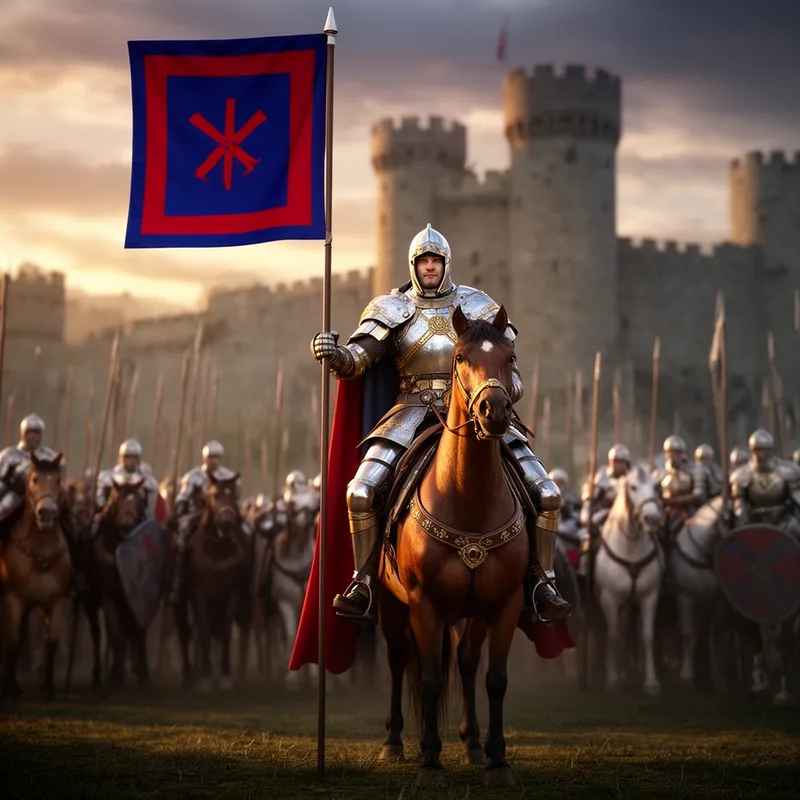
knight of the square flag
- noun
- Archaic
 :
caballero de la bandera cuadrada
:
caballero de la bandera cuadrada
- Earning the title of knight of the square flag was a rare honor in medieval chivalry.
Examples
-
He proudly rode into battle as a knight of the square flag, his banner waving high.
-
The knight of the square flag led his troops with distinction during the siege.
-
The knight of the square flag led the charge into battle.
-
Did you hear about the knight of the square flag?
-
Earning the title of knight of the square flag was a rare honor in medieval chivalry.
-
He proudly rode into battle as a knight of the square flag, his banner waving high.
-
The knight of the square flag led his troops with distinction during the siege.
Synonyms
A knight honored for bravery who can lead soldiers under his square flag
A knight who leads his own troops under a square banner
Antonyms



Surface Forms
Morphology
knight + of + the + square + flag
The phrase is largely compositional: a B1 learner who knows 'knight', 'square' and 'flag' can infer it refers to a knight associated with or bearing a square flag. However, the specific institutional meaning — that this marks exceptional valor, entitlement to display a square banner, and higher command — is culturally specific and not predictable from the literal constituents, so the expression is only partially transparent.
Etymology
Knight of the square flag may come from the Middle Ages when a special knight was allowed to carry a square flag as a sign of rank and honour. Seeing that banner showed he had great bravery and led others, so the phrase came to mean 'a knight recognized for great bravery and higher command'.