
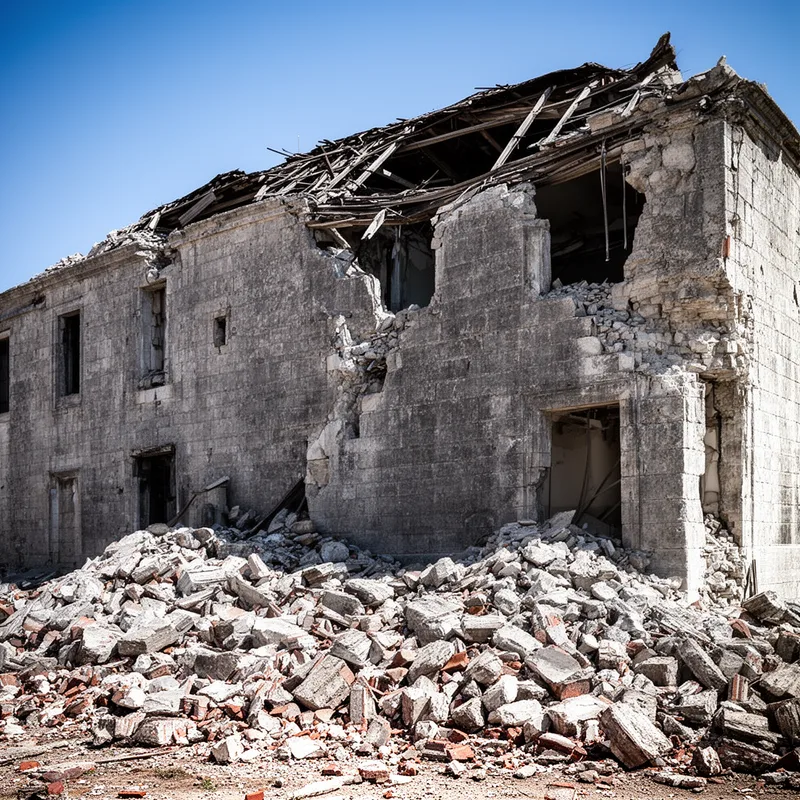
in ruins
 23
3.8
23
3.8

- idiom
- The once-thriving town is now in ruins, a stark reminder of the war that ravaged it.
- lies in ruins
- house in ruins
Loading YouTube…
Watch on YouTubeBy the end of August, the city will be in ruins.
- By the end of August, the city will be in ruins.
- The old house that had been the center of the domain was half in ruins on its hill among the oaks.
- It's a old, old sugar plantation that was in ruins on this hill.
- Armenia is in ruins and partial starvation.
Examples
-
Bankrupt and with his press interests in ruins, Nadir no longer posed a danger to his fellow proprietors.
Academic text (2000) -
His marriage was in ruins.
-
So everyone turned on each other and now the country is in ruins.
-
We went to a city that lay in ruins and asked if it had been hit.
Academic text (2002) -
Most of the town was in ruins, but not all of it.
Fiction book (1990) -
His plan lay in ruins and there was no prospect for victory.
-
A land in ruins, its people torn apart!
-
Not only was the peace mission in ruins, but he, a Federation ambassador, was thought to be a murderer.
Fiction book (1992) -
In 1945, with Germany in ruins, little thought was given to placing the Germans back into uniform.
Academic text (1990) -
Tens of thousands are feared dead after a 7.0-magnitude earthquake left much of the capital city of Port-au-Prince in ruins.
Synonyms
 24
4.4
24
4.4
In very poor condition and not working because of age or neglect
 18
6.2
18
6.2
A building that is very old and badly damaged because no one fixed it
 14
7.5
14
7.5
A place or building that is abandoned and in very bad condition from lack of use
 10
7.5
10
7.5
Old and in very bad condition, like a house about to fall down
 8
6.4
8
6.4
So badly torn and ruined that it cannot be used, like clothes or plans
 8
9.1
8
9.1
In a very bad state and not doing well, like a business losing money
 7
4.3
7
4.3
Badly damaged or destroyed by fire
 2
5.3
2
5.3
Badly damaged or destroyed, like a building after a disaster
 1
6.2
1
6.2
An area badly damaged by fire


 1
3.1
1
3.1
Badly damaged so it cannot be fixed or returned to how it was before
 1
4.8
1
4.8
Feeling very upset because hopes or feelings are destroyed
Very badly damaged and no longer usable, often after a war or storm

Made into many small pieces so it cannot be fixed
A building that has been torn down and broken up

Badly damaged by violence or natural disaster

Badly damaged after an accident or disaster
Antonyms


How Damaged

Surface Forms
Morphology
The phrase is compositional: 'in' marks location or state and 'ruins' denotes destroyed remains, so a learner who knows both words can infer 'in a state of destruction or severe disrepair.' The figurative extension (e.g. an economy 'in ruins') follows the same predictable metaphorical mapping and is cross-linguistically common, making it readily understandable.
Etymology
In ruins comes from the clear image of buildings with broken walls, fallen stones and empty rooms left as ruins after war or a disaster. That's why it means 'destroyed' or 'in very bad condition', and people use it for places, objects, or even organizations that have been badly damaged.