
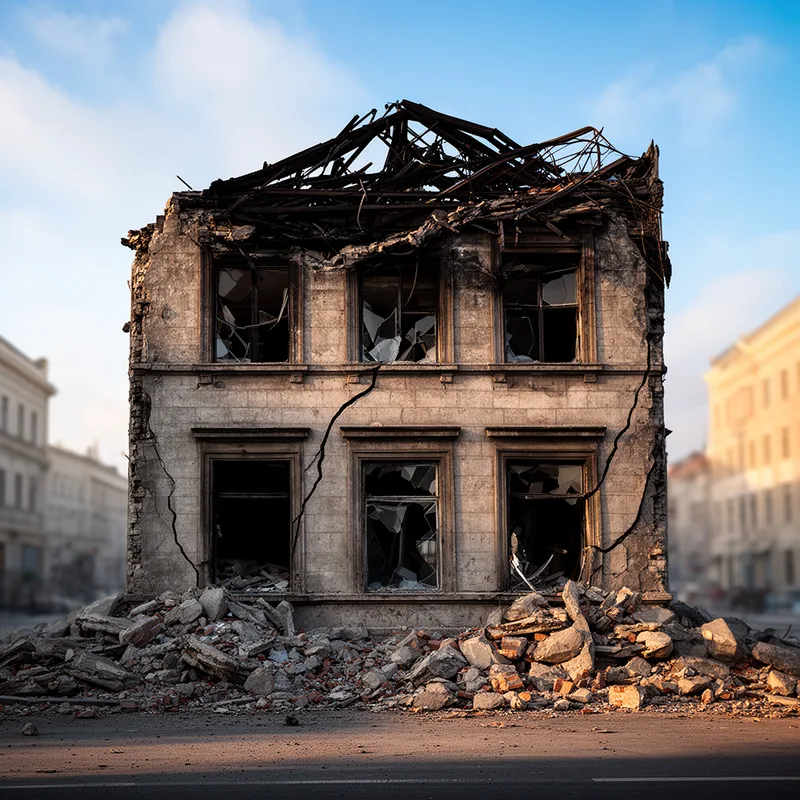
left in ruins
 2
5.3
2
5.3

- idiom
- After the invasion, the city was left in ruins, buildings reduced to rubble and streets empty.
- left a city in ruins
- left the nation in ruins
- left her life in ruins
Examples
-
In his wake, much of the world was left in ruin as the entire land mass of Valerian sunk into the sea.
-
I go from being a respected public servant to being the media's new story of the week, soon to be forgotten while my life is left in ruins.
-
But men, your men, continue to die, their families left in ruins.
-
You left it all in ruins.
-
Some beautiful architecture left in ruins...
Blog text (27) -
The city is left in ruins, its gates battered down.
Blog text (32) -
Reports are unclear as to the extent of the devastation, but, from all accounts, Los Angeles, Washington, and New York have been left in ruins...
-
Four more years of Obama's "flexibility" and defense cuts will leave the US military in ruins and unable to defend US allies, or even the US homeland, from Russia and China.
Blog text (7) -
Then a sudden destruction and burning came upon the land, leaving those cities in ruins and bringing in a new period known as the Late Bronze Age, matching the time of Egypt's New Kingdom.
-
The earthquake left the entire town in ruins, with collapsed buildings and shattered lives.
Synonyms
 23
3.8
23
3.8
A place or thing that is very badly damaged, often used for buildings and companies
 15
5.5
15
5.5
A place badly damaged and in ruins because of war
 8
6.4
8
6.4
So badly torn and ruined that it cannot be used, like clothes or plans
 7
4.3
7
4.3
Badly damaged or destroyed by fire
 1
6.2
1
6.2
An area badly damaged by fire


 1
3.1
1
3.1
Badly damaged so it cannot be fixed or returned to how it was before
 1
4.8
1
4.8
Feeling very upset because hopes or feelings are destroyed
Very badly damaged and no longer usable, often after a war or storm

Badly damaged after an accident or disaster

Badly damaged by violence or natural disaster
A building that has been torn down and broken up

Destroyed completely so nothing is left standing

Completely destroyed so nothing is left

Made into many small pieces so it cannot be fixed
Antonyms

How Damaged

Surface Forms
Morphology
The meaning 'destroyed or severely damaged' is directly derivable from combining 'leave' (to cause or result in a state), 'in' (indicating state/position), and 'ruins' (a ruined state); the pattern 'left in X' transparently means 'caused to be in X'. This is a regular compositional English construction and is cross-linguistically common, so a B1 learner who knows the constituents would readily infer the meaning.
Etymology
The phrase left in ruins comes from the image of buildings or towns left as ruins, with broken walls and piles of stone after war or fire. So when something is left in ruins, it is 'destroyed' or very badly damaged, and we can use it for places or for things like hopes or plans.