

hydrolysis
 1
7.4
1
7.4

- noun
- /haɪˈdrɒlɪsɪs/
- Specialized
- A labeled Hoxa-11 probe was subjected to alkaline hydrolysis to obtain optimal signals.
- hydrolysis of ATP
- acid hydrolysis
- hydrolysis of anhydride
Examples
-
In the laboratory, scientists studied the process of hydrolysis to understand how water can break down complex molecules.
-
A number of experiments were carried out to prove the polarity effect on hydrolysis.
Academic text (2001) -
A goal is to complete the acid hydrolysis phase within 2 minutes.
Academic text (1996) -
This is an alkaline hydrolysis machine.
-
Conventional methods to improve digestibility have included hydrolysis, chemical, and enzymatic processing.
Academic text (2018) -
So I think as we all know, proteases catalyze the hydrolysis of peptide bonds.
-
The rate of hydrolysis of fluorescein diacetate defines this property of composts and amended soils.
Academic text (2000) -
Carboxylesterase 1 is a serine esterase, responsible for the hydrolysis of ester- and amide-bond-containing substrates, including xenobiotics and drugs.
Academic text (2018) -
In its simplest form, the LD regulates the storage and hydrolysis of neutral lipids, including triacylglycerol and/or cholesterol esters.
Blog text (27) -
The hydrolysis of starch during digestion produces glucose, which the body uses for energy.
Synonyms
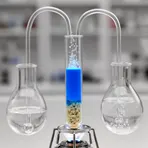
A reaction where one compound breaks into two or more simpler substances

A chemical reaction where one compound breaks into two or more different substances
Surface Forms
Morphology
Etymology
The word hydrolysis comes from the Greek parts hydro- meaning 'water' and -lysis meaning 'to break'. So hydrolysis is literally 'water breaking', and it describes a chemical reaction where water splits a compound into smaller parts.