
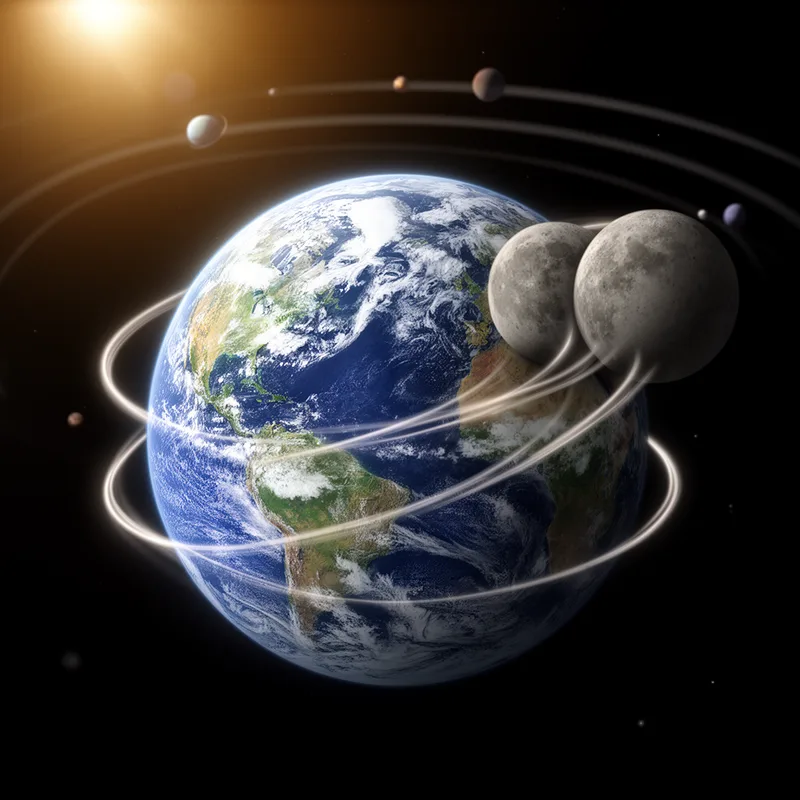
gravitational interaction
 1
6.8
1
6.8

- noun
- /ˌɡrævɪˈteɪʃənəl ˌɪntəˈrækʃən/
- Specialized
- As Wolszczan continued observing B1257+12, he began to see the effects of the gravitational interactions of the planets, even though the magnitude of these effects is only one hundred-thousandth of a second.
Examples
-
The gravitational interaction between M51 and its companion is likely causing gas to fall into M51's nucleus, perhaps boosting the energy of its central black hole.
Academic text (1992) -
Even more complex behavior takes place when we consider the gravitational interactions among ring particles.
Academic text (1995) -
Then we need to worry about the gravitational interaction between the moon and the ring particles.
Academic text (1995) -
As a result, the gravitational interaction between the two tends to pull back on the gas and pull forward on the planet.
Academic text (1999) -
The three-body problem involves calculating the gravitational interactions of three bodies, for example, the Earth, Moon, and Sun.
Academic text (1992) -
When speaking about rings, astronomers use the word "resonances" to refer to the gravitational interactions that can create areas of stability between different objects.
Academic text (2001) -
The Bolshoi simulation kicks in before the gravitational interactions in this increasingly lumpy universe start to show nonlinear effects.
Blog text (27) -
The detection of gravitational interactions has convinced most astronomers that the timing oscillations are due to planetary objects, rather than other processes.
Academic text (1995) -
After millions of years in orbit about the star, the chunks are flung by chaotic gravitational interactions into interstellar space.
Academic text (1996) -
In the late 17th century, Newton showed that a planet's orbit could be calculated from its gravitational interaction with the sun.
Synonyms
 335
2.3
335
2.3
The force that makes things fall to the ground and keeps planets moving
 7
4.2
7
4.2
A pull between all objects, especially Earth's pull on things near its surface
 4
4.1
4
4.1
A force that pulls objects toward each other and makes things fall to Earth
 1
4.1
1
4.1
The force that pulls two objects toward each other, for example toward a planet


 1
3.4
1
3.4
The pull that makes things fall toward Earth or another large body
Surface Forms
Morphology
The meaning is directly compositional: 'gravitational' (pertaining to gravity) modifies 'interaction' (a mutual action), so a learner who knows both words can infer it denotes the interaction caused by gravity between bodies. Although it is a scientific term, the components combine in a literal and cross-linguistically transparent way, so the sense is immediately recoverable from the constituents.
Etymology
Gravitational interaction combines gravitational (about gravity) and interaction (an effect between things) to describe the invisible 'pull' between things like the Earth and the Moon. So, it means the 'pull' that keeps planets moving around stars and makes tides.