

to force back
 10
4.9
10
4.9

- phrasal verb
- The creatures grinned to one another, forcing the humans back into a circle.
Loading YouTube…
Watch on YouTubeSo they are forced back into this lifestyle where the men can.
- So they are forced back into this lifestyle where the men can.
- And so I think being being forced back to to that was actually the best thing that could have happened to me.
Examples
-
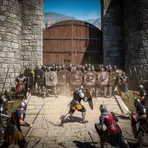
Aragorn and a group of warriors are fighting hand-to-hand, being forced back by scores of ape infantry.
Fiction book (1996) -
The Germans have been forced back to their old line at the edge of the forest.
-
And six times was forced back by the severest storms.
-
The Missilians were forced back into port having lost more than half their ships, and the blockade continued.
-
As the week went on, the Bulgarians and the Germans were forced back by the French and Serbs and the Allies were almost due east of Monastier.
-
Catti-brie didn't flinch, didn't blink; her determined stare forced Wulfgar back a step.
Fiction book (1992) -
The soldier bravely forced back the enemy with a powerful charge.
-
The defenders used barricades to force back the advancing waves of attackers.
-
She used her authority to force back the protestors from the entrance.
Synonyms
 97
3.9
97
3.9
Force a person or thing to move backward in body and feeling
 21
4.2
21
4.2
Make someone or something move back and stay away, often by using force
 19
4.1
19
4.1
Force someone or something to move away from danger
 14
6.0
14
6.0
To force someone or something to move away
 7
7.0
7
7.0
To make someone or something go away
 3
7.9
3
7.9
To drive back an attack or enemy force
How Forceful
14
6.0
 19
4.1
21
4.2
10
4.9
97
3.9
187
3.2
19
4.1
21
4.2
10
4.9
97
3.9
187
3.2
Surface Forms
Morphology
The meaning 'to make someone or something move backward' is directly and transparently derived from combining 'force' (apply strength) with 'back' (toward the rear). This simple causative motion construction follows standard English verb + directional particle patterns and is common cross-linguistically, so a B1 learner who knows both constituents will readily infer the MWE's meaning.
Etymology
Force back comes from the simple image of using force to push someone or something toward the back, making them move away. That's why it means 'to push away' or 'to hold something in', as when you 'force back' tears.