

equinoctial year
- noun
- /ˌɛkwɪˈnɒkʃəl jɪr/
- Specialized
- The equinoctial year lasts about 365.2424 days.
Examples
-
The equinoctial year is slightly shorter than the sidereal year due to the precession of the equinoxes.
-
The duration of the equinoctial year determines the timing of many cultural events tied to the vernal equinox.
-
Astronomers consider the equinoctial year when defining calendars based on seasonal cycles.
-
An equinoctial year is crucial for understanding Earth's movement.
-
Astronomers consider the equinoctial year when defining calendars based on seasonal cycles.
-
The equinoctial year is slightly shorter than the sidereal year due to the precession of the equinoxes.
-
The duration of the equinoctial year determines the timing of many cultural events tied to the vernal equinox.
Synonyms

 1
3.7
1
3.7

The time it takes the Earth to go once around the Sun, about 365 days
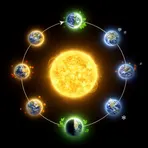
The time the Earth takes to go once around the Sun from one spring equinox to the next

Time Earth takes to go around the Sun from one spring equinox to the next
Surface Forms
Morphology
Given knowledge of 'equinoctial' (occurring at or relating to the equinoxes) and 'year' (a period of one orbit/12 months), a learner can infer this is the year defined by equinoxes — i.e., the period between successive equinoxes. Although the term is technical, its meaning is compositionally derived from its parts and follows a predictable English formation, so it is transparently understandable to someone who knows both constituents.
Etymology
Equinoctial year comes from equinox, a word meaning 'equal night' because day and night are almost the same length at those times. It means a year measured from one 'spring equinox' to the next, so the name helps you remember it counts a full trip of Earth around the sun by the return of that equal-night point.