

equinoctial
- adjective
- /ˌɛkwɪˈnɒkʃəl/
- Above the pale line of unleafed cottonwoods along the stream and the reddish stems of salt cedar that crowd the banks, the Canyon's cliffs lift into the morning's equinoctial light.
Examples
-
The equinoctial period marks the arrival of spring when day and night are of equal length.
-
Many animals exhibit unique behaviors during the equinoctial transition between seasons.
-
The equinoctial equinox occurs around March 21st, signaling the start of spring in the northern hemisphere.
Compounds

- Specialized
An imaginary circle across the sky midway between the north and south poles

- Specialized
An imaginary line in the sky that matches Earth's equator and divides the sky into north and south

- Specialized
A point in the sky where the Sun crosses the Earth's equator at spring or autumn equinox

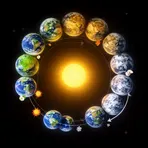
- Specialized
The time Earth takes to go from one spring equinox to the next, about 365.24 days
Surface Forms
Morphology
Etymology
Equinoctial comes from the Latin parts aequus 'equal' and nox 'night', just like the word equinox. So equinoctial means 'happening when day and night are equal', which is why it describes events at the equinox.

