
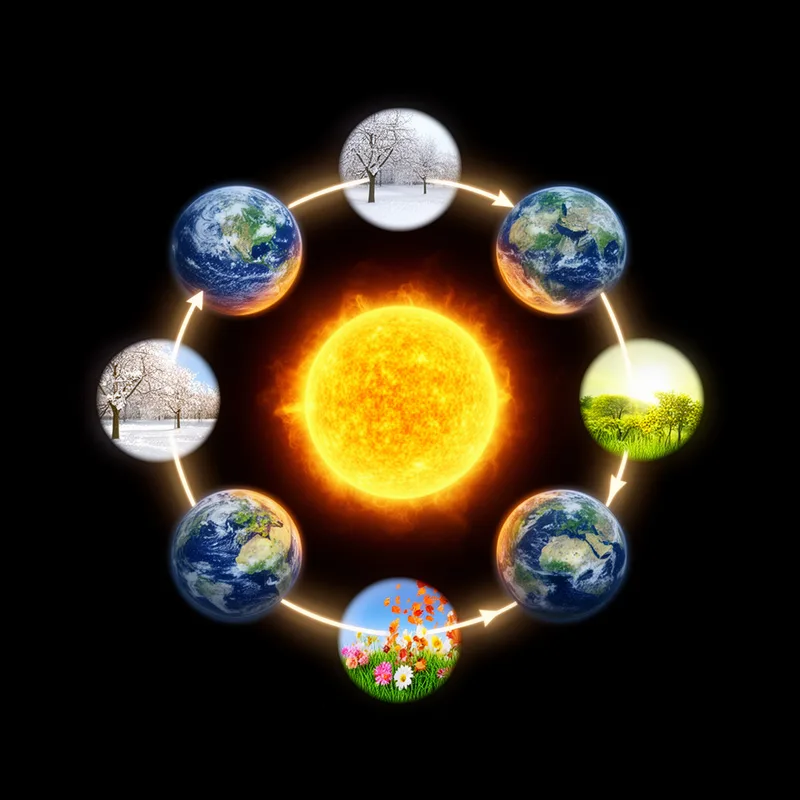
solar year
 1
3.7
1
3.7

- noun
- /ˈsoʊlər jɪr/
- The solar year is approximately 365.24 days long, marking the duration of Earth's orbit around the Sun.
Loading YouTube…
Watch on YouTubeSo it's miserably off a solar year.
- So it's miserably off a solar year.
Examples
-
Every 5 years, two intercalary periods were added to bring the calendar back in line with the solar year, ensuring that years averaged 366 days.
Blog text (17) -
Called the Siddhantic Era, it began with a series of books called the Siddhanat, 'Solutions,' which charted the solar year, including solstices, equinoxes, lunar periods, solar and lunar eclipses, and planetary movements.
Blog text (17) -
The battle of Donatu V was fought near here 23 solar years ago.
-
Their calculation of the solar year, in fact, was more accurate than our Gregorian calendar.
Academic text (2004) -
Because the Muslim year consists of twelve cycles of the moon, it is 354 days long—some eleven days short of a solar year.
Academic text (2004) -
The reason such a question arises at all is that the Aztecs employed a value of 365 days for the length of their secular calendar, although the true length of the solar year is about one-quarter of a day longer than that.
Academic text (1992) -
He observed a slight difference between the solar year (the time it takes the earth to revolve around the sun) and the stellar or sidereal year (the time it takes the sun to realign with the stars).
Academic text (2009) -
Many cultures have developed calendars based on the solar year to track seasonal changes.
-
To understand climate patterns, scientists often study the solar year and how it influences weather conditions.
Synonyms
The time the Earth takes to go once around the Sun from one spring equinox to the next

Time Earth takes to go around the Sun from one spring equinox to the next
The time Earth takes to go from one spring equinox to the next, about 365.24 days
Antonyms


Surface Forms
Morphology
The compound is directly compositional: 'solar' means 'pertaining to the sun' and 'year' means a yearly period, so a B1 learner who knows both constituents can infer it refers to a year defined by the sun (i.e., the sun-based orbital period). While the precise technical detail (vernal equinox, 365.24 days) is specialized, the core meaning is transparent and cross-linguistically paralleled in many languages.
Etymology
Solar year links solar (the Sun) and year (one trip around the Sun). It means the time Earth takes to go once around the Sun, about '365 days and a quarter', so we add a leap day every four years.