
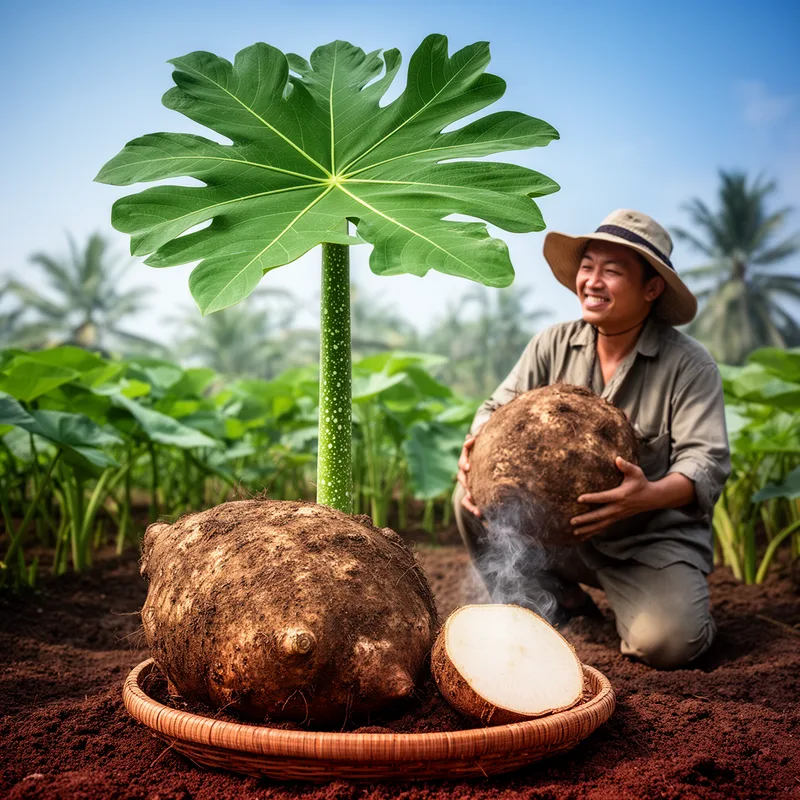
elephant yam
- noun
- Indian
- Despite its strong odor, elephant yam is popular in traditional Filipino dishes.
Examples
-
The roots of the elephant yam are harvested and eaten as a delicacy in many Asian countries.
-
Farmers in India often cultivate elephant yam for its high nutritional value and commercial potential.
-
The elephant yam is known for its large size.
-
Have you ever tasted elephant yam?
-
Despite its strong odor, elephant yam is popular in traditional Filipino dishes.
-
Farmers in India often cultivate elephant yam for its high nutritional value and commercial potential.
-
The roots of the elephant yam are harvested and eaten as a delicacy in many Asian countries.
Synonyms

A tropical plant with a large edible tuber used as food and a strong bad-smelling flower

A large tropical plant from Southeast Asia that has a strong bad smell and farmers grow for its edible root

A tropical plant with a very bad smell grown for its edible root

A plant with a very strong smell grown in Southeast Asia for its edible root like a potato
Surface Forms
Morphology
elephant + yam
The compound is compositionally predictable: 'elephant' signals large size and 'yam' is a starchy edible root, so a B1 learner who knows both words can infer it denotes a very large yam-like plant or tuber. While finer botanical details (aroid family, putrid smell, regional origin) are not deducible, the basic meaning is transparently built from the constituents.
Etymology
Elephant yam may get its name from the very large, rough root that looks a bit like an elephant's foot, so people combined elephant and yam to describe it. So, the name helps you remember it is a big, strong-smelling 'root' eaten as a vegetable.

