

Amorphophallus campanulatus
- noun
- Specialized
- Farmers cultivate Amorphophallus campanulatus for its edible tubers and starchy roots.
Examples
-
The tuber of Amorphophallus campanulatus is often used as a vegetable in Southeast Asian cuisine.
-
Because of its strong odor, Amorphophallus campanulatus is sometimes called the 'stinky yam' in local markets.
-
The Amorphophallus campanulatus has a strong odor that attracts insects.
-
Have you ever seen a Amorphophallus campanulatus in bloom?
-
In Southeast Asia, Amorphophallus campanulatus is commonly known as the 'stinky yam' due to its unpleasant smell.
-
Many chefs in the Philippines use Amorphophallus campanulatus as a key ingredient in traditional recipes.
-
The edible tuber of Amorphophallus campanulatus is highly valued for its unique flavor and texture.
Synonyms

A large plant from Asia with a strong smell grown for its edible root
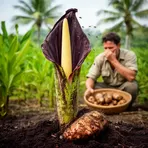
A tropical plant with a very bad smell grown for its edible root

A plant with a very strong smell grown in Southeast Asia for its edible root like a potato
Surface Forms
Morphology
amorphophallus + campanulatus
This is a Latin binomial (genus + species). A learner who knows 'Amorphophallus' as a plant genus can transparently infer that this is a particular species of that genus, but the specific properties (putrid smell, edible tuber) and the species epithet 'campanulatus' are not lexically transparent or provided here, so the full meaning is not derivable from the parts. The binomial naming convention is cross-linguistically regular, giving taxonomic transparency at the level of 'a species of X' but leaving the detailed sense opaque.
Etymology
Amorphophallus campanulatus has a very large, bell-like flower and a strong bad smell that attracts flies, and its scientific name comes from old words: amorphophallus meaning 'odd stalk' and campanulatus meaning 'bell-shaped'. So the name helps you remember this smelly, bell-shaped plant people grow for its edible tuber.

