
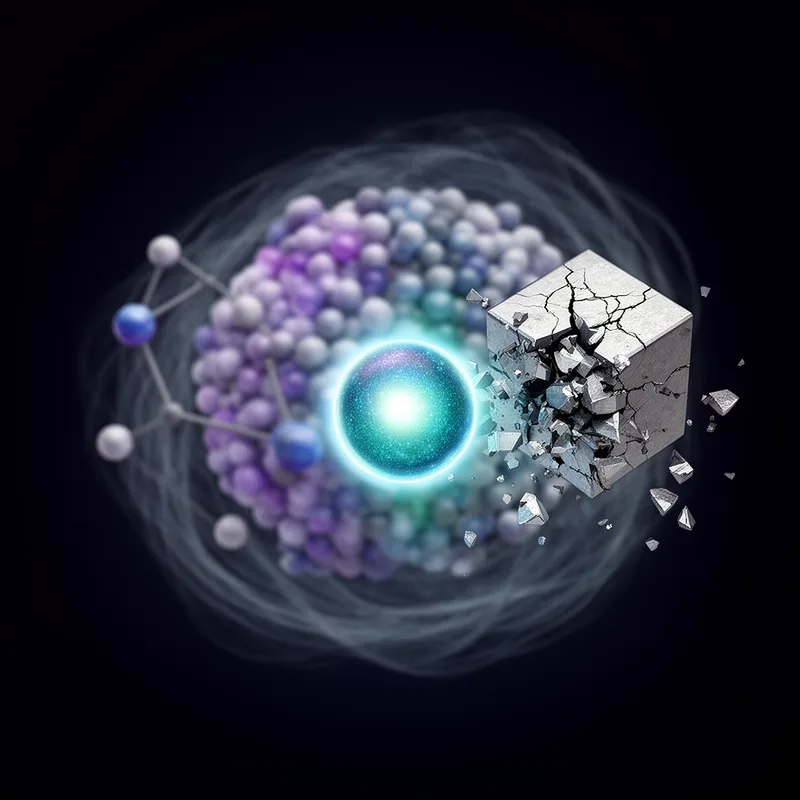
elementary particle
 3
6.5
3
6.5

- noun
- /ˌɛlɪˈmɛnˌtɛri ˈpɑrtɪkl/
- Specialized
- In physics, an electron is one type of elementary particle that serves as a fundamental building block of matter.
- elementary-particle physics
- elementary-particle physicists
- elementary particle phenomena
Loading YouTube…
Watch on YouTubeSeems like there's no such thing as friction at the level of elementary particles.
- Seems like there's no such thing as friction at the level of elementary particles.
- This is why panpsychism, which assigns consciousness to everything, including elementary particles, is either bluntly wrong.
- But some years ago, a Muscovite called Boris Mikhailovich Russakov discovered a new kind of elementary particle.
- This means that if elementary particles were wormholes or black holes, they'd be much smaller than the quantum uncertainty that we measure.
- So the M is not only a elementary particle, it can be just an object.
- Every electron seems to reuse the same subprogram all the time as it is interacting with other elementary particles.
- But if I wanted to describe, I don't know, the sort of interactions of matter and light, you know, I have elementary particles be fundamental.
Examples
-
Michael Zeller is an experimental elementary particle physicist concentrating on weak interactions employing K mesons.
Blog text (33) -
Gravity shows its stuff in the larger world, the world that consists of immense numbers of elementary particles.
Academic text (1991) -
All the known elementary particles fall into two very general types.
Academic text (1997) -
The standard model of elementary particles does not contain such a process.
-
Well, all those elementary particles in the standard model are defined by their quantum numbers.
-
Over the course of a century, six leptons have been discovered in the universe of elementary particles.
Academic text (1997) -
The Higgs boson is the explanation for what gives elementary particles their mass.
Blog text (10) -
A central collision at RHIC typically creates thousands of pions and other elementary particles.
Academic text (2003) -
The basic premise of a GUT is that the known symmetries of all elementary particles result from a larger symmetry group.
Academic text (2005) -
Following his equations to their logical conclusion, Dirac also predicted that, for each elementary particle, there exists a corresponding antiparticle.
Academic text (2005)
Synonyms
 1
6.8
1
6.8
A very small part of matter not made of smaller parts like an electron or quark
Antonyms
How Fundamental
- Specialized
3
6.5

- Specialized
12
5.1
- Specialized
1
8.0
- Specialized
10
5.8
- Specialized
170
3.5
- Specialized
209
3.4
Surface Forms
Morphology
The noun phrase simply combines 'elementary' (basic, fundamental) with 'particle' (a very small bit), so its meaning — a fundamental/basic particle — is directly derivable from the constituents. Although it's a technical physics term, the compositional pattern is regular and cross-linguistically common, so a B1 learner who knows both words would likely understand it.
Etymology
Elementary particle comes from the idea of tiny building blocks of matter: elementary means 'basic' and particle means a small piece. Scientists used the picture of pieces that cannot be broken into smaller parts, so today elementary particle means a smallest 'building block' like an electron or quark.