
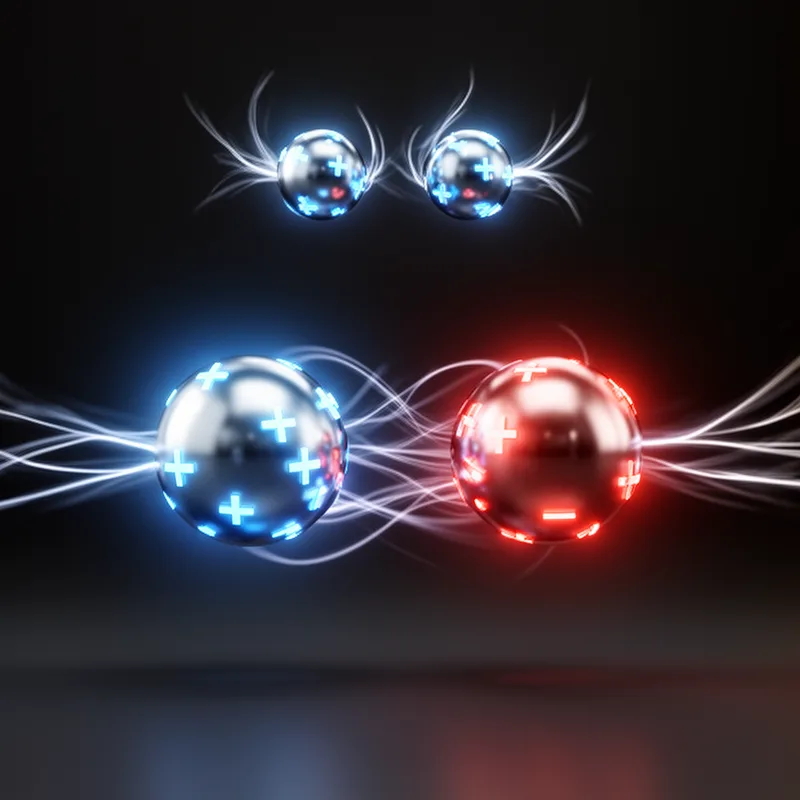
electric charge
 2
3.9
2
3.9

- noun
- /ɪˈlɛktrɪk tʃɑrdʒ/
- Specialized
- The electric charge of an electron is negative, while that of a proton is positive.
- fractional electric charge
- particles with electric charge
- carry a substantial electric charge
Loading YouTube…
Watch on YouTubeFor one thing, as we already saw, they'd explain why electric charges come in discrete units.
- For one thing, as we already saw, they'd explain why electric charges come in discrete units.
- And the most likely interpretation is that it's a swarm of microscopic particles which have no electric charge.
- OK, it's biggest closer to the source of the electrical charge or the source of the electromagnetic field, and it tails off with distance.
- But the in the Feynman diagram that you would draw for this kind of process, there's one line that sort of contains electric charge.
Examples
-
Adding to the complexity is that humans frequently carry a substantial electric charge that also influences the background electrical field.
Academic text (2003) -
The electric charge is fading, anyway.
-
I felt this electric charge!
-
But each application of the electric charge...
-
Then the electric charge that you'll see will increase.
-
For example, electric charge is conserved.
-
When an electric charge was put on them, the charged leaves repelled one another and stood apart.
Academic text (1990) -
Two flexible closed wires, such as two rings, linked through one another and carrying static electric charges provide a simple example.
Academic text (1996) -
According to Maxwell's laws of electromagnetism, an electric charge moving in a magnetic field gives rise to electromagnetic radiation.
Academic text (1996) -
Macklin felt like he'd just been zapped with an electric charge.
Fiction book (2002)
Synonyms
 98
6.7
98
6.7
The amount of electricity in a battery or object
Antonyms


Surface Forms
Morphology
The noun phrase combines 'electric' (relating to electricity) with 'charge' (an excess or deficiency of electrons) in a straightforward, compositional way; the compound meaning is essentially the sum of its parts and follows a regular English adjective+noun pattern. This concept is expressed similarly in many languages (e.g., Spanish 'carga eléctrica'), so a B1 learner who knows the constituent meanings will readily understand the term.
Etymology
Electric charge comes from the image of tiny, invisible bits that carry a charge, like many little batteries on an object. If an object has more or fewer of these bits it becomes 'positive' or 'negative' and will pull or push other things, so electric charge means how much of that electric 'charge' it has.