

decohesion
- noun
- /ˌdiːkoʊˈhiːʒən/
- The decohesion of the materials led to a failure in the structure, causing it to collapse unexpectedly.
Examples
-
His current work in dynamic fracture includes the use of fiber-optical sensors, photoelasticity, and strain gauges in the study of the dynamic decohesion and failure of bimaterial interfaces and composites.
Academic text (1996) -
Despite the apparent heterogeneous and complex interfacial microstructure, the lattice images demonstrate that the crystalline structure is preserved throughout the interfacial region with no indication of local decohesion.
Academic text (2018) -
In the experiment, decohesion occurred when the temperature increased, causing the layers to separate.
-
The scientists observed decohesion at the molecular level, demonstrating how the components lost their unity.
Synonyms

 39
3.6
39
3.6

A separation into parts when something falls apart
 19
4.1
19
4.1
A process in which a substance is broken into simpler parts by chemicals or living things
 14
4.4
14
4.4
The act of taking a machine or system apart
 6
6.2
6
6.2
Something breaks into smaller pieces and falls apart
 5
6.3
5
6.3
Breaking something into small pieces, often by force
 4
4.9
4
4.9
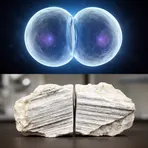
A split into parts along natural lines, for example in rocks or cells
 3
5.9
3
5.9
The act of taking a machine or building apart into separate parts
 2
5.2
2
5.2
To take something apart, often a machine, so you can fix or check it


 1
7.9
1
7.9
Breaking a whole into smaller separate parts
 1
5.0
1
5.0
Separating things that were joined before, for example train cars

Separation of parts that are normally joined in a structure or machine

Two surfaces that do not stick together
Antonyms

How Cohesive

Surface Forms
Morphology
Etymology
Decohesion comes from the prefix de- meaning 'remove' and cohesion meaning 'sticking together', the same idea behind adhere. So, decohesion is the process or state when parts stop sticking together and come apart.