
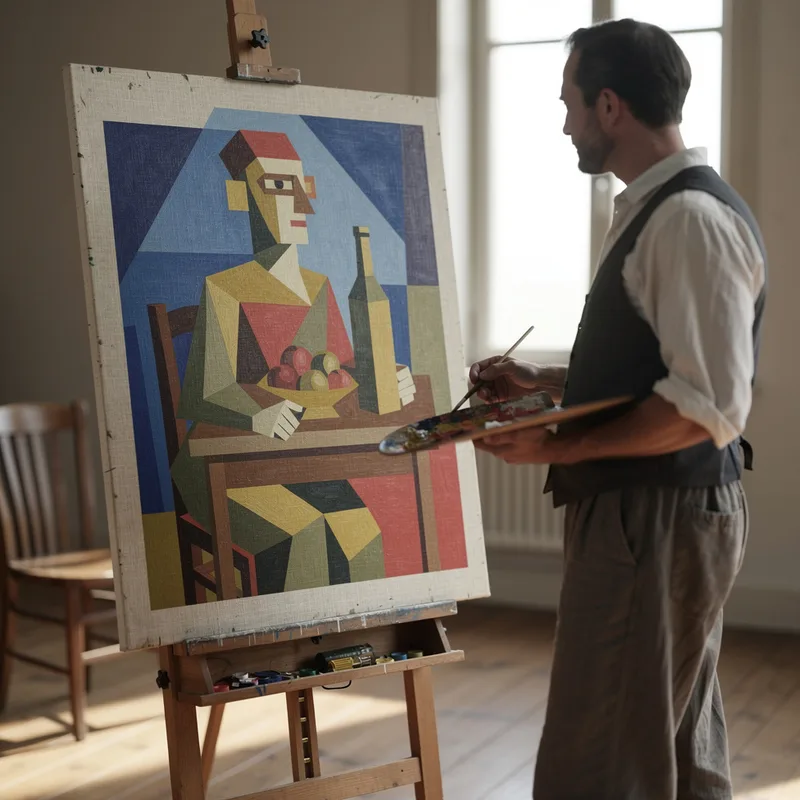
cubism
 3
7.5
3
7.5

- noun
- /ˈkjuːbɪzəm/
- One of the ambitions of the artistic movement of cubism was to present an object simultaneously from various angles.
- the aesthetics of cubism
- Analytic Cubism
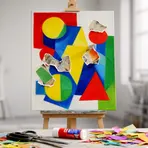
- Synthetic Cubism
Loading YouTube…
Watch on YouTubeAnd so then we get all this impressionism, expressionism, Cubism.
- And so then we get all this impressionism, expressionism, Cubism.
- We know Cubism is something that Picasso and Brock sort of birthed in the in in early part of the century in Paris.
Examples
-
In the last decade, photography has fallen under the influence of the latest trends in art: Cubism.
Academic text (2000) -
Picasso left behind the work of his "Blue Period" to start painting what would later be called Cubism.
Fiction book (2001) -
His photographs of African objects, particularly those that feature multiple exposures, are reminiscent of Cubism.
Academic text (1999) -
Cubism shatters the complacencies of vision only to offer us the jagged sightlines of competing perspectives.
Academic text (2008) -
The art exhibition featured several striking works of cubism, showcasing objects from multiple perspectives.
-
Many famous artists, including Pablo Picasso, are associated with the revolutionary movement known as cubism.
-
Cubism transformed the way artists represented reality by using geometric shapes and fragmented forms.
Compounds

An early painting style that shows objects as flat geometric shapes and uses soft colors
- Specialized
A later painting style with simple shapes, bright colors, and glued paper pieces
How Abstract
- Specialized

 1
8.9
1
8.9
 3
3.9
3
7.5
6
7.9
12
6.1
3
3.9
3
7.5
6
7.9
12
6.1
Surface Forms
Morphology
Etymology
Cubism comes from cube, which means 'a box' or 'a square block'. Artists used box-like shapes and flat planes to show many sides of an object at once, so the name fits the movement's style.