

cubist
 2
7.4
2
7.4

- adjective
- /ˈkjuːbɪst/
- After Man Ray saw Marcel Duchamp and other cubist works, he decided to vividly create colored cubist compositions and anti-artistic creations.
- cubist collage
- cubist painter
- cubist composition
Loading YouTube…
Watch on YouTubeBut he would do whatever it is that he were boxing, you know, some, some cubist painter.
- But he would do whatever it is that he were boxing, you know, some, some cubist painter.
- But give me a farmer's market to park my marded mass and I will name all the dirt roads that dead end at the cubist sculpture called My Infinity.
- So he switches to his blue period and switches to his Cubist period and so on, just because he's now competing with himself.
Examples
-
Nick has this sort of cubist tie in sharp, expressionist orange and green.
Fiction book (1998) -
Thus, Ang Lee must create a narrative from what is essentially a cubist and fragmentary piece of work.
Academic text (2009) -
Now, let me see the latest addition to my cubist collection.
-
The highest form of cubist abstraction.
-
An imposing cubist castle of black glass.
Fiction book (1991) -
And here I have the Cubist liquid eyeliner, just in black.
-
Cubist collage: introduction into the painting of a piece of reality.
Academic text (2005) -
The famous Damosel d'avignon, the first completely cubist painting, and the opening salvo in the battle for modern art.
-
The strictly cubist composition splinters into fragments of deconstructed and carefully rearranged forms, having at times only marginal mimetic reference.
Academic text (1994) -
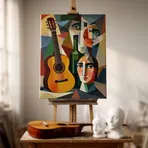
The artist's latest work is a stunning example of cubist style, featuring bold geometric shapes.
Synonyms
 1
9.1
1
9.1
Like art that shows objects as simple flat shapes seen from many views
How Cubist


Surface Forms
Morphology
Etymology
Cubist comes from the art movement Cubism, a name given when a critic said the new paintings looked like 'little cubes'. Think of a cube to remember it, because cubist describes art that breaks things into flat, geometric shapes.