
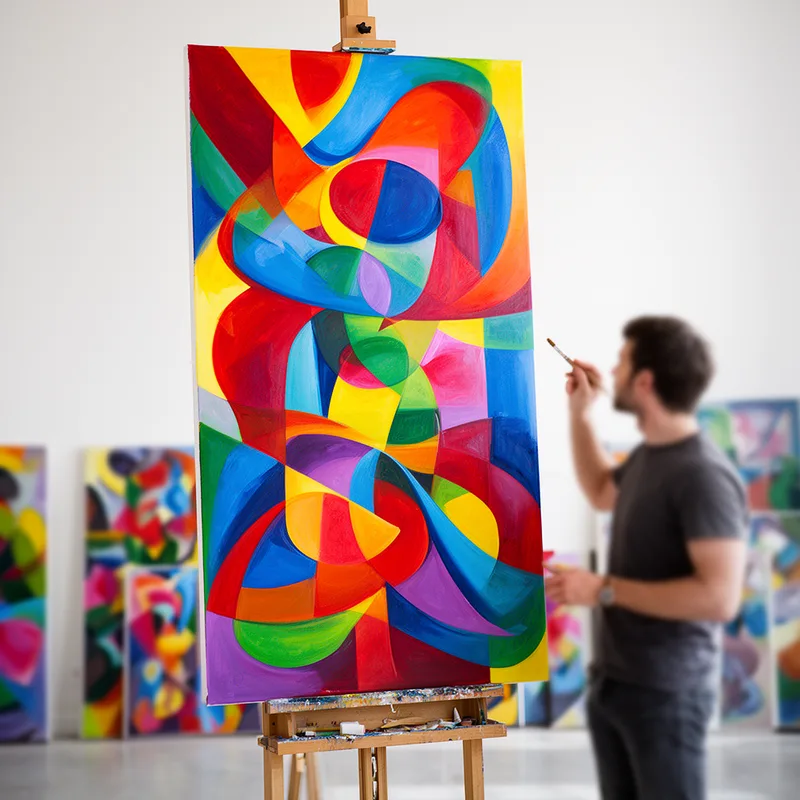
nonrepresentational


 1
8.9
1
8.9
- adjective
- /ˌnɒnˌrɛprɪzɛnˈteɪʃənl/
- Specialized
- To be sure, semblance, for Adorno (and no less for Benjamin), is more than referential illusionism; he considers most striking the extent to which the crisis of semblance, qua harmony, has affected music, the most nonrepresentational of arts.
- nonrepresentational forms
Examples
-
Spiraling lines, more monkey business but nonrepresentational, suggest a "motif," and on the littoral the whorled sea shells repeat it.
Fiction book (1991) -
Visual artists, for example, communicate in realistic or nonrepresentational images as the case might be.
Academic text (1995) -
If shape and color are content elements in a film, and it is a nonrepresentational film, what is the form of the film?
Academic text (1998) -
In Germany and Russia, in particular, performances increasingly emphasized nonrepresentational movement.
Academic text (2003) -
But there are many nonrepresentational films that have form, such as Diagonalsymphonie.
Academic text (1998) -
These images could be called nonrepresentational or aniconic, except that many of them are strongly iconic, and even more closely similar to their objects than fine-art images.
Academic text (1995) -
Saharan jewels are nonrepresentational.
Academic text (2001) -
For example, Drewal's complex analysis of Yoruba commemorative masquerades helps us to see the logic underlying their nonanthropomorphic, nonrepresentational imagery.
Academic text (1990) -
Unsurprisingly, perhaps, the theoretically rich and corporeally resonant (but safely nonrepresentational) sphere of architecture suggested it to eighteenth-century English culture as a place to debate and define new sexual and social norms in a way it had not been used before.
Academic text (2013) -
The artist's latest exhibit features entirely nonrepresentational works that invite viewers to interpret shapes and colors freely.
Synonyms
 35
7.1
35
7.1
Art that uses shapes and colours instead of real objects
 1
8.3
1
8.3
Art that does not show real people or things but uses shapes and colors
Art that does not show real people or things but uses shapes and colors

Not meant to copy real things, often showing abstract shapes or colours
Relating to art that uses shapes and colors rather than real people or things
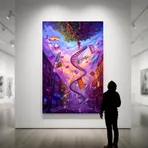
Not showing things as they are in real life, often like a dream

Not trying to show life as it really is, often using dream images or symbols
Antonyms

How Representational

Surface Forms
Morphology
nonrepresentational = representational (transparent) = non + represent + ation + al
The adjective is clearly formed by adding the productive prefix 'non-' to 'representational', yielding a straightforward negation.
Etymology
Nonrepresentational breaks down into non- meaning 'not' and represent meaning 'to show' or 'to picture', so it literally means 'not showing' real things. That's why nonrepresentational art is abstract: it focuses on color and shape instead of pictures of people or places.